Genetically Synthesized Supergain Broadband Wire-Bundle Antenna
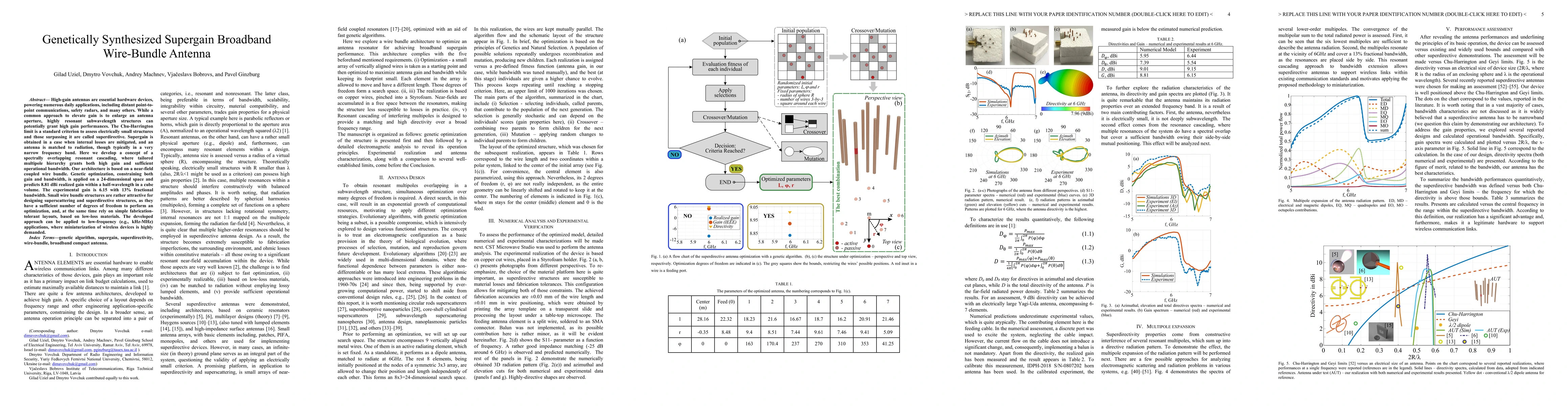
This paper presents a genetically synthesized supergain broadband wire-bundle antenna that achieves high gain and operational bandwidth through a spectrally overlapping resonant cascading design. The genetic optimization method predicts a realized gain of 8.81 dBi, with an experimental gain of 6.15 dBi and a 13% fractional bandwidth.
Abstract
High-gain antennas are essential hardware devices, powering numerous daily applications, including distant point-to-point communications, safety radars, and many others. While a common approach to elevate gain is to enlarge an antenna aperture, highly resonant subwavelength structures can potentially grant high gain performances. The Chu-Harrington limit is a standard criterion to assess electrically small structures and those surpassing it are called superdirective. Supergain is obtained in a case when internal losses are mitigated, and an antenna is matched to radiation, though typically in a very narrow frequency band. Here we develop a concept of a spectrally overlapping resonant cascading, where tailored multipole hierarchy grants both high gain and sufficient operational bandwidth. Our architecture is based on a near-field coupled wire bundle. Genetic optimization, constraining both gain and bandwidth, is applied on a 24-dimensional space and predicts 8.81 dBi realized gain within a half-wavelength in a cube volume. The experimental gain is 6.15 with 13% fractional bandwidth. Small wire bundle structures are rather attractive for designing superscattering and superdirective structures, as they have a sufficient number of degrees of freedom to perform an optimization, and, at the same time rely on simple fabrication-tolerant layouts, based on low-loss materials. The developed approach can be applied to low-frequency (e.g., kHz-MHz) applications, where miniaturization of wireless devices is highly demanded.
AI Key Findings
Get AI-generated insights about this paper's methodology, results, significance, and more — available when analysis has been generated.
Discussion 0