This paper proposes a giant rectification scheme in strongly-interacting driven quantum systems, showing that the interplay of strong interactions and a tilted potential can lead to a rectification coefficient of many orders of magnitude. The authors attribute these phenomena to enhanced coherences at avoided crossings in the system's energy spectrum.
Abstract
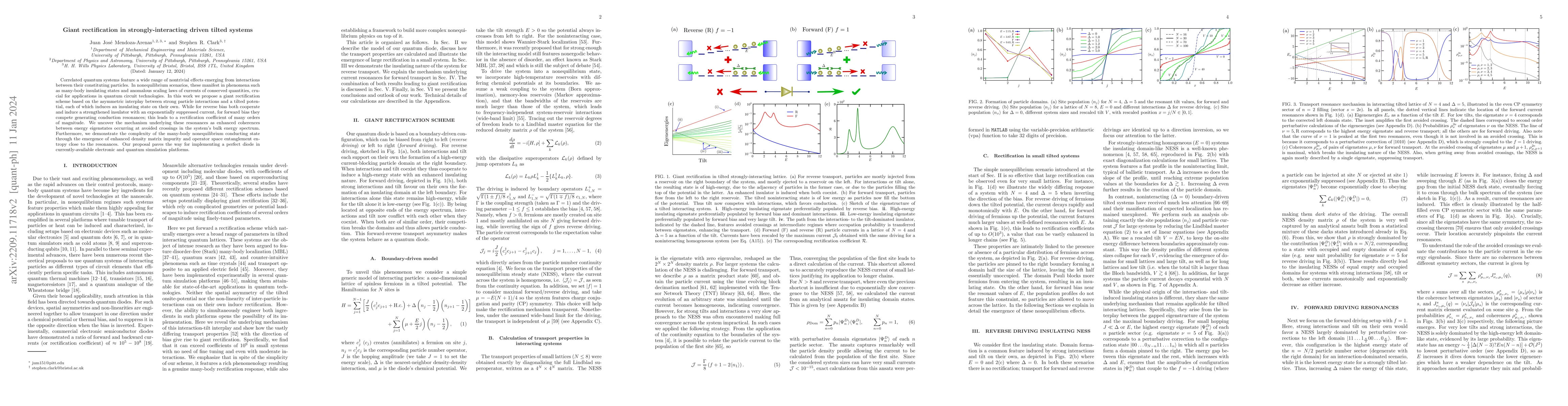
Correlated quantum systems feature a wide range of nontrivial effects emerging from interactions between their constituting particles. In nonequilibrium scenarios, these manifest in phenomena such as many-body insulating states and anomalous scaling laws of currents of conserved quantities, crucial for applications in quantum circuit technologies. In this work we propose a giant rectification scheme based on the asymmetric interplay between strong particle interactions and a tilted potential, each of which induces an insulating state on their own. While for reverse bias both cooperate and induce a strengthened insulator with an exponentially suppressed current, for forward bias they compete generating conduction resonances; this leads to a rectification coefficient of many orders of magnitude. We uncover the mechanism underlying these resonances as enhanced coherences between energy eigenstates occurring at avoided crossings in the system's bulk energy spectrum. Furthermore, we demonstrate the complexity of the many-body nonequilibrium conducting state through the emergence of enhanced density matrix impurity and operator space entanglement entropy close to the resonances. Our proposal paves the way for implementing a perfect diode in currently-available electronic and quantum simulation platforms.
AI Key Findings
Get AI-generated insights about this paper's methodology, results, significance, and more — available when analysis has been generated.
Discussion 0