This paper develops a distributed inference framework for social networks, proposing a novel distributed estimator and observability based on graph-theoretic agent classification. It characterizes necessary conditions for achieving distributed observability and demonstrates applicability across various real-world social networks.
Abstract
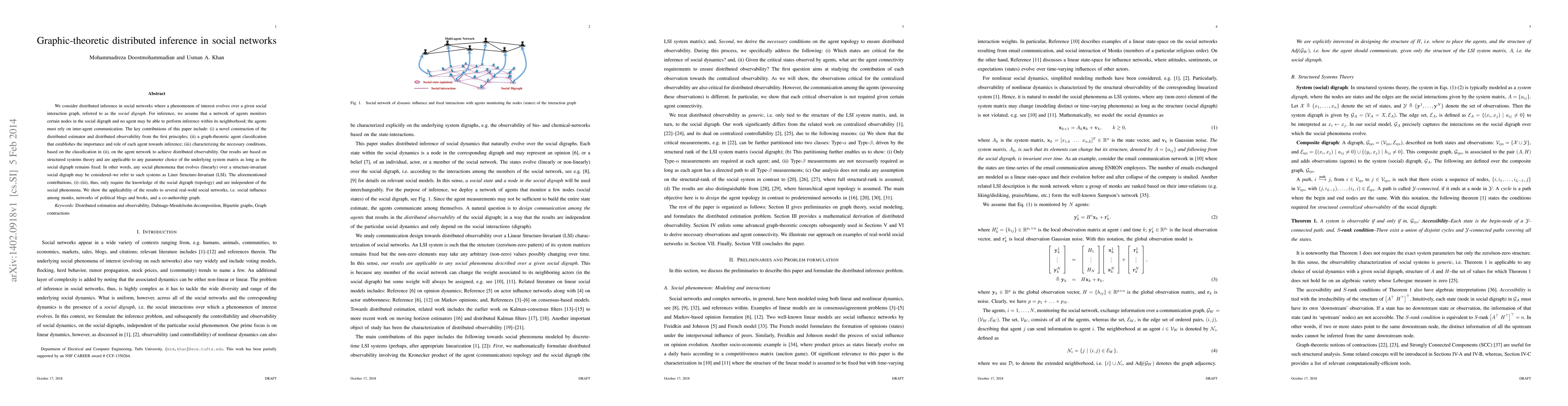
We consider distributed inference in social networks where a phenomenon of interest evolves over a given social interaction graph, referred to as the \emph{social digraph}. For inference, we assume that a network of agents monitors certain nodes in the social digraph and no agent may be able to perform inference within its neighborhood; the agents must rely on inter-agent communication. The key contributions of this paper include: (i) a novel construction of the distributed estimator and distributed observability from the first principles; (ii) a graph-theoretic agent classification that establishes the importance and role of each agent towards inference; (iii) characterizing the necessary conditions, based on the classification in (ii), on the agent network to achieve distributed observability. Our results are based on structured systems theory and are applicable to any parameter choice of the underlying system matrix as long as the social digraph remains fixed. In other words, any social phenomena that evolves (linearly) over a structure-invariant social digraph may be considered--we refer to such systems as Liner Structure-Invariant (LSI). The aforementioned contributions, (i)--(iii), thus, only require the knowledge of the social digraph (topology) and are independent of the social phenomena. We show the applicability of the results to several real-wold social networks, i.e. social influence among monks, networks of political blogs and books, and a co-authorship graph.
AI Key Findings
Get AI-generated insights about this paper's methodology, results, significance, and more — available when analysis has been generated.
Discussion 0