Greedy Decoding Hides Good Plans: Sample-and-Verify Planning for Vision-Language Driving Models
Abstract
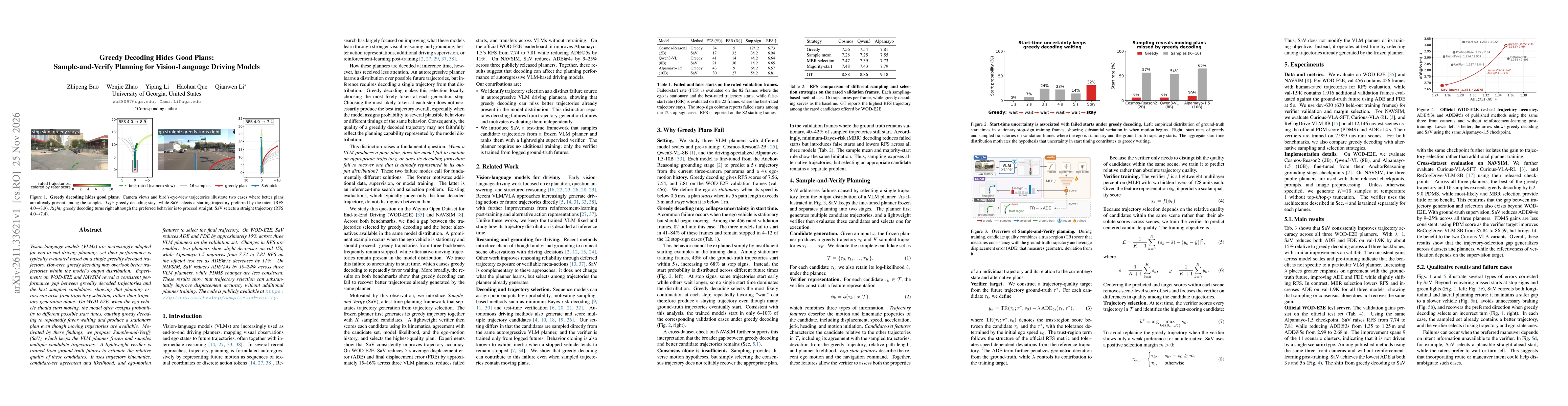
Vision-language models (VLMs) are increasingly adopted for end-to-end driving planning, yet their performance is typically evaluated based on a single greedily decoded trajectory. However, greedy decoding may overlook better trajectories within the model's output distribution. Experiments on WOD-E2E and NAVSIM reveal a consistent performance gap between greedily decoded trajectories and the best sampled candidates, showing that planning errors can arise from trajectory selection, rather than trajectory generation alone. On WOD-E2E, when the ego vehicle should start moving, the model often assigns probability to different possible start times, causing greedy decoding to repeatedly favor waiting and produce a stationary plan even though moving trajectories are available. Motivated by these findings, we propose Sample-and-Verify (SaV), which keeps the VLM planner frozen and samples multiple candidate trajectories. A lightweight verifier is trained from ground-truth futures to estimate the relative quality of these candidates. It uses trajectory kinematics, candidate-set agreement and likelihood, and ego-motion features to select the final trajectory. On WOD-E2E, SaV reduces ADE and FDE by approximately 15% across three VLM planners on the validation set. Changes in RFS are smaller: two planners show slight decreases on val-456, while Alpamayo-1.5 improves from 7.74 to 7.81 RFS on the official test set as ADE@5s decreases by 11%. On NAVSIM, SaV reduces ADE@4s by 10-24% across three VLM planners, while PDMS changes are less consistent. These results show that trajectory selection can substantially improve displacement accuracy without additional planner training. The code is publicly available at https://github.com/hzxbzp/sample-and-verify.
Analysis
AI-generated · verify against the original paper
Generated Jan 1, 0001ResultsWhat the authors found
- SaV reduces average displacement error (ADE) and final displacement error (FDE) by approximately 15% on the Waymo Open Dataset for End‑to‑End driving (WOD‑E2E) across three VLM planners.
- On the official WOD‑E2E test set, Alpamayo‑1.5 improves its route‑following score (RFS) from 7.74 to 7.81 while decreasing ADE@5s by 11%.
- On the NAVSIM benchmark, SaV lowers ADE@4s by 10–24% across three VLM planners, with mixed effects on PDMS.
- SaV also reduces failed‑start incidents by selecting moving trajectories that greedy decoding often misses.
LimitationsWhere the findings need caution
- Evaluations are limited to two simulated benchmarks (WOD‑E2E and NAVSIM), leaving real‑world deployment untested.
- Performance gains on the route‑following score (RFS) are modest and sometimes inconsistent across planners.
- The verifier is lightweight and may not capture more complex safety or comfort constraints.
MethodologyHow the work was done
The paper proposes Sample-and-Verify (SaV), a test-time framework that keeps a pretrained vision‑language driving planner frozen, samples multiple candidate trajectories from its autoregressive output distribution, and trains a lightweight verifier on ground‑truth futures to rank candidates using trajectory kinematics, candidate‑set agreement, likelihood, and ego‑motion features, selecting the highest‑scoring plan.
SignificanceWhy the work matters
The work demonstrates that trajectory selection at inference time can substantially improve planning accuracy without any additional training of the underlying vision‑language model, highlighting decoding as a distinct source of error in autoregressive driving planners.
Technical contributionsWhat the work introduces
Decoupling trajectory generation from selection by introducing a test‑time sampling and verification pipeline that leverages a frozen VLM planner and a learned verifier to improve planning outcomes without retraining the planner.
NoveltyHow it differs from prior work
Identifying greedy decoding as a distinct failure mode in vision‑language driving models and proposing a test‑time Sample‑and‑Verify approach that improves trajectory quality solely through inference‑time selection.
Future workQuestions that remain
- Extend the Sample‑and‑Verify framework to additional datasets and real‑world driving scenarios.
- Develop richer verification models that incorporate safety, comfort, and interaction metrics.
- Explore joint training of the verifier and planner or adaptive sampling strategies to reduce computational overhead.
Discussion 0