Grokking as a Subspace Search: Computing the Destination Before Training
Abstract
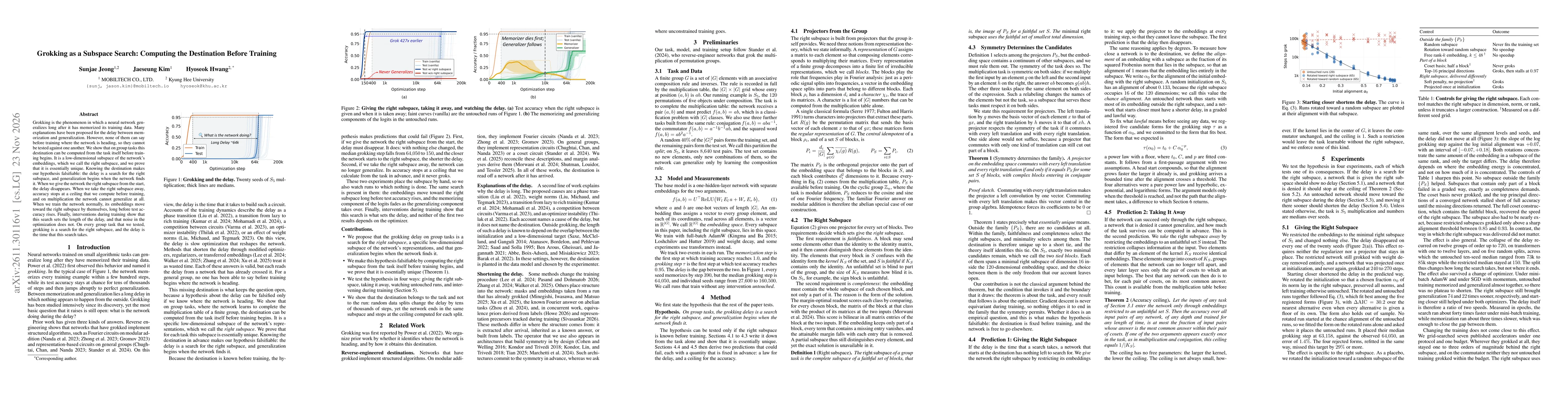
Grokking is the phenomenon in which a neural network generalizes long after it has memorized its training data. Many explanations have been proposed for the delay between memorization and generalization. However, none of them can say before training where the network is heading, so they cannot be tested against one another. We show that on group tasks this destination can be computed from the task itself before training begins. It is a low-dimensional subspace of the network's embeddings, which we call the right subspace, and we prove that it is essentially unique. Knowing the destination makes our hypothesis falsifiable: the delay is a search for the right subspace, and generalization begins when the network finds it. When we give the network the right subspace from the start, the delay disappears. When we take the right subspace away, accuracy stops at a ceiling that we compute before training, and on multiplication the network cannot generalize at all. When we train the network normally, its embeddings move toward the right subspace by themselves, long before test accuracy rises. Finally, interventions during training show that this search sets the length of the delay, and that noise in the optimization does not. On every group task that we tested, grokking is a search for the right subspace, and the delay is the time that this search takes.
AI Key Findings
Get AI-generated insights about this paper's methodology, results, significance, and more — available when analysis has been generated.
Discussion 0