GSPIM: A Temporal-Locality-Aware 4D Gaussian Splatting Accelerator with Polymorphic PIM and Multi-Frame Rendering Dataflow
Abstract
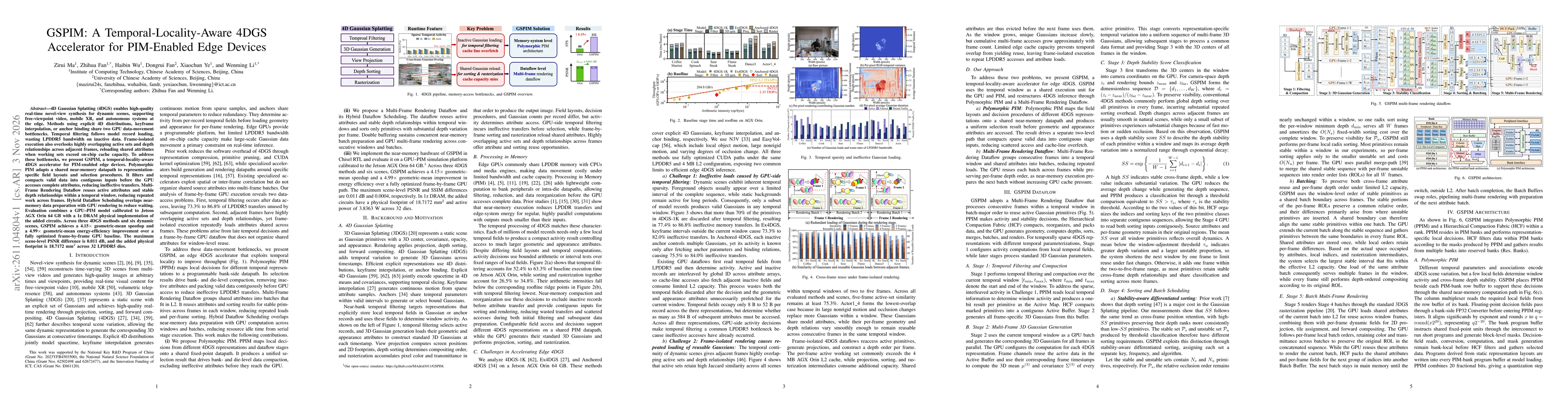
4D Gaussian Splatting (4DGS) enables high-quality real-time novel-view synthesis for dynamic scenes, supporting free-viewpoint video, mobile XR, and autonomous systems at the edge. Methods using explicit 4D distributions, keyframe interpolation, or anchor binding share two GPU data-movement bottlenecks. Temporal filtering follows model record loading, wasting LPDDR5 bandwidth on inactive data. Frame-isolated execution also overlooks highly overlapping active sets and depth relationships across adjacent frames, reloading shared attributes when working sets exceed on-chip cache capacity. To address these bottlenecks, we present GSPIM, a temporal-locality-aware 4DGS accelerator for PIM-enabled edge devices. Polymorphic PIM adapts a shared near-memory datapath to representation-specific field layouts and selection procedures. It filters and compacts valid data into contiguous inputs before the GPU accesses complete attributes, reducing ineffective transfers. Multi-Frame Rendering Dataflow reuses active attributes and stable depth relationships within a temporal window, reducing repeated work across frames. Hybrid Dataflow Scheduling overlaps near-memory data preparation with GPU rendering to reduce waiting. Evaluation combines a GPU-PIM model calibrated to Jetson AGX Orin 64 GB with a 1z DRAM physical implementation of the added circuits. Across three 4DGS methods and six dynamic scenes, GSPIM achieves a 4.15x geometric-mean speedup and a 4.99x geometric-mean energy-efficiency improvement over a fully optimized frame-by-frame GPU baseline. The maximum scene-level PSNR difference is 0.011 dB, and the added physical footprint is 18.7172 square millimeters across 32 LPDDR5 dies.
Analysis
AI-generated · verify against the original paper
Generated Jan 1, 0001ResultsWhat the authors found
- Achieves a 4.15× geometric‑mean speedup over a fully optimized frame‑by‑frame GPU baseline across three 4DGS methods and six dynamic scenes.
- Delivers a 4.99× geometric‑mean improvement in energy efficiency.
- Maximum scene‑level PSNR degradation is only 0.011 dB (SSIM drop 0.0004).
- The added physical footprint of the near‑memory circuits is 18.7172 mm² across 32 LPDDR5 dies, with an active power of 3.8363 W.
LimitationsWhere the findings need caution
- Evaluation relies on a GPU‑PIM simulation calibrated to Jetson AGX Orin and a 1z DRAM physical implementation, not a full silicon prototype.
- Experiments cover only three 4DGS methods and six scenes, limiting generality to other representations or larger workloads.
MethodologyHow the work was done
GSPIM combines a Polymorphic PIM (PPIM) that maps representation‑specific field layouts and selection logic onto a shared near‑memory datapath, performing temporal filtering and compaction of active records before GPU access, with a Multi‑Frame Rendering Dataflow that batches shared attributes across a temporal window and reuses stable depth relationships; a Hybrid Dataflow Scheduling overlaps near‑memory preparation with GPU rendering to hide latency.
SignificanceWhy the work matters
GSPIM demonstrates that temporal‑locality‑aware near‑memory processing can dramatically reduce data‑movement bottlenecks in 4D Gaussian splatting, enabling high‑quality real‑time novel‑view synthesis on edge devices with limited bandwidth and cache capacity.
Technical contributionsWhat the work introduces
Introduces a polymorphic near‑memory processing unit that performs representation‑specific temporal filtering and data compaction, coupled with a multi‑frame rendering dataflow that reuses active attributes and depth ordering across frames, together with hybrid scheduling to overlap memory preparation and GPU rendering.
NoveltyHow it differs from prior work
First accelerator to combine polymorphic PIM with multi‑frame rendering for 4D Gaussian splatting, exploiting temporal locality to cut ineffective LPDDR5 transfers and redundant attribute loads.
Future workQuestions that remain
- Extend the Polymorphic PIM framework to support additional 4DGS representations and larger temporal windows.
- Implement and validate the accelerator in a full silicon prototype to assess real‑world performance and reliability.
- Explore scaling the approach to higher‑resolution scenes and integration with other edge AI workloads.
Discussion 0