GTI: Grounding Task Intent Throughout Long-Horizon VLA Manipulation
Abstract
Vision-language-action (VLA) models generate local actions from visual observations, language, and robot state, but long-horizon manipulation requires the global task intent to remain grounded in the currently executable context. We propose GTI (Grounding Task Intent), which uses the current observation and execution history to localize the active subtask and its execution phase. For the same local subtask, GTI generates two phase-dependent visual targets: an interaction/contact state and a local completion state. The local language instruction and the corresponding phase-specific visual target jointly condition the VLA, specifying both what to do now and what state should be reached at the current phase. During execution, anomaly monitoring and local recovery re-establish an intent-consistent execution context through rollback, re-observation, and phase re-evaluation after persistent deviation. We evaluate GTI on RoboCasa365, VLA-Arena Horizon-Long, and real-world PiPER tasks. Relative to matched Global-FT baselines, GR00T success on seen composite RoboCasa365 tasks increases from 14.6%/12.1% to 31.8%/20.4% under ID/OOD evaluation. On VLA-Arena, GTI+$π_{0.5}$ reaches 47.6% overall success versus 45.2% for an adapted ForeAct baseline, with gains of 5.2/6.0 percentage points on the harder L1/L2 tasks. In the three real-robot task experiments, mean full-task success increases from 21.7% to 59.2%. The results indicate that persistent semantic intent localization and phase-conditioned visual grounding improve multi-stage execution, while failure-triggered local recovery provides additional deployment-time support.
Analysis
AI-generated · verify against the original paper
Generated Jan 1, 0001ResultsWhat the authors found
- On RoboCasa365, GTI raises seen composite task success from 14.6%/12.1% to 31.8%/20.4% under ID/OOD evaluation.
- On VLA‑Arena Horizon‑Long, GTI+π0.5 achieves 47.6% overall success versus 45.2% for the adapted ForeAct baseline, with gains of 5.2 and 6.0 percentage points on the harder L1 and L2 tasks.
- In three real‑robot PiPER tasks, mean full‑task success increases from 21.7% to 59.2%, with stage‑wise improvements such as Task1‑B rising from 0/30 to 12/30 and swapping from 4/30 to 23/30.
LimitationsWhere the findings need caution
- Performance still depends on planning quality, milestone feasibility, low‑level interaction, and error correction; GTI complements rather than replaces the VLA.
- Complex held‑out tasks and cross‑scene generalization remain difficult.
- The K1/K2 visual milestones can be too coarse for repeated contacts, re‑grasping, or mid‑course strategy switches.
MethodologyHow the work was done
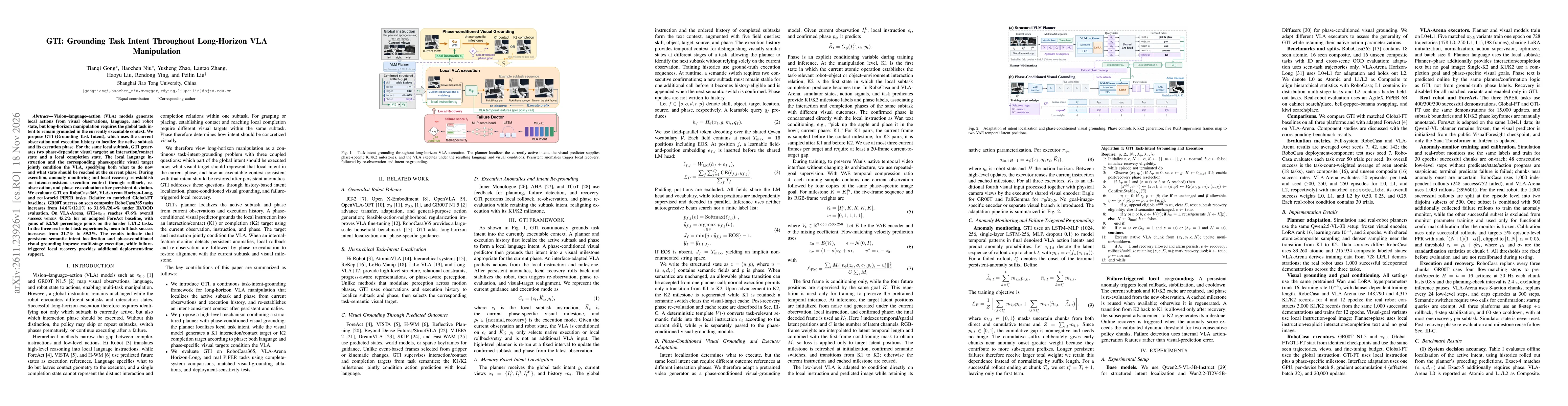
GTI combines a memory‑based planner that uses current observations and execution history to localize the active subtask and its phase, a phase‑conditioned visual predictor that generates interaction/contact (K1) or completion (K2) visual milestones for the localized subtask, and a VLA model conditioned on the local language instruction and visual milestone; persistent anomalies trigger a local recovery that rolls back, re‑observes, and re‑evaluates the phase to re‑ground intent.
SignificanceWhy the work matters
The work demonstrates that continuously grounding global task intent through history‑based subtask/phase localization and phase‑specific visual targets substantially improves multi‑stage long‑horizon manipulation, and that failure‑triggered local recovery adds practical deployment robustness.
Technical contributionsWhat the work introduces
GTI introduces a unified framework that fuses high‑level intent localization, phase‑conditioned visual grounding, and anomaly‑driven local recovery to enable robust long‑horizon VLA manipulation.
NoveltyHow it differs from prior work
First approach to continuously ground global task intent throughout long‑horizon VLA execution by jointly localizing subtask phase from history and providing phase‑specific visual targets, coupled with a dedicated local recovery loop.
Future workQuestions that remain
- Develop finer‑grained phase definitions and task‑level replanning mechanisms.
- Integrate stronger interaction policies and more precise visual milestones.
- Explore extensions that allow global replanning or alternative strategy selection during recovery.
Discussion 0