H-SAGE: Holistic Speaker-Aware Guided Experts for MoE-based Multi-Talker ASR
Abstract
Multi-talker Automatic Speech Recognition (MTASR) faces significant challenges in accurately transcribing overlapping speech, particularly under complex high-overlap conditions. While recent Mixture-of-Experts (MoE) approaches have shown promise, they typically rely on frame-independent routing that leads to temporal myopia, and depend solely on the downstream ASR objective, which results in implicit and ungrounded representation learning. To address these limitations, we propose Holistic Speaker-Aware Guided Experts (H-SAGE) for MoE-based MTASR. Specifically, we introduce a Speaker-Aware Global Encoder to capture long-term dependencies, supervised by an auxiliary Overlap-Aware Loss that explicitly guides the model to discern acoustic states. Furthermore, we design a Holistic Gating Mechanism to arbitrate expert selection by jointly evaluating global context and local details. Experiments on LibriSpeechMix demonstrate that H-SAGE achieves consistent improvements over strong baselines, particularly in complex scenarios, validating that explicit acoustic guidance effectively enhances expert collaboration. Our code can be found at https://github.com/NKU-HLT/H-SAGE.
Analysis
AI-generated · verify against the original paper
Generated Jul 4, 2026ResultsWhat the authors found
- S5 (full H-SAGE) outperforms all baselines on LSM-2mix and shows notable gains in high-overlap conditions, while maintaining parity with strong baselines on clean single-speaker data.
- Zero-shot 3-mix scenarios see substantial improvements with explicit LOA, indicating better generalization to unseen speaker counts.
- Ablation confirms necessity of SA-Encoder and Holistic Gating; removing either reduces performance, especially in complex mixtures.
- Holistic gating yields benefits beyond local cues, particularly in complex entanglements, by combining global context with local representations.
- Optimal LOA weight (λ≈3) balances overlap awareness and ASR accuracy, with overemphasis harming the primary transcription task.
LimitationsWhere the findings need caution
- Performance gap remains in certain two-speaker conditions where SA-Encoder alone can suffice, suggesting domain dependence on overlap complexity.
- Zero-shot generalization, while improved, can still lag in extremely variable speaker counts or unseen acoustic environments not represented in LibriSpeechMix.
- Model complexity and training cost increase due to MoLE blocks and auxiliary LOA supervision, potentially impacting scalability.
MethodologyHow the work was done
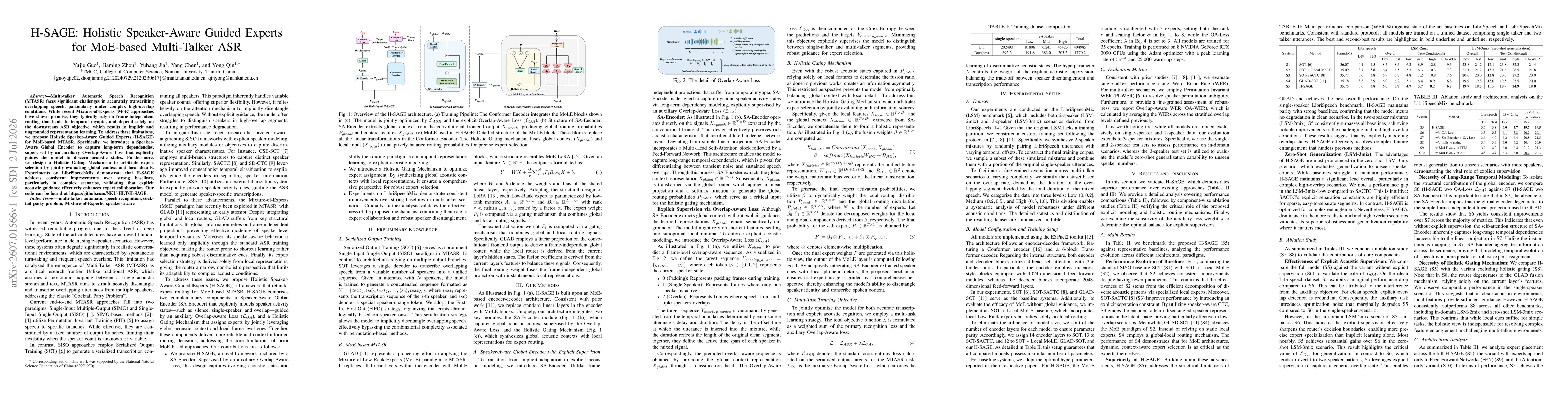
H-SAGE introduces two main components within a MoE-based MTASR encoder-decoder: (1) a Speaker-Aware Global Encoder (SA-Encoder) that explicitly models speaker activity states (silence, single-speaker, overlap) guided by an auxiliary Overlap-Aware Loss (LOA), and (2) a Holistic Gating Mechanism that fuses global context and local frame-level cues to arbitrate expert selection. The MoLE (Mixture of Low-Rank Experts) blocks replace standard linear layers in the Conformer encoder, allowing global and local routing signals to determine expert weights. Training optimizes both LASR objectives and LOA to encourage explicit acoustic guidance, with ablation studies confirming the necessity of long-range temporal modeling and holistic gating for robust multi-talker disentanglement. Experiments on LibriSpeechMix demonstrate improvements over strong baselines, especially under high overlap, validating the effectiveness of explicit acoustic supervision and holistic routing.
SignificanceWhy the work matters
The work demonstrates that explicit acoustic-state supervision and holistic, context-aware routing can substantially improve MoE-based MTASR, addressing temporal myopia and implicit representation learning in prior methods, and enabling better robustness in high-overlap scenarios.
Technical contributionsWhat the work introduces
Propose a novel MoE-based MTASR architecture, H-SAGE, featuring a Speaker-Aware Global Encoder with LOA supervision and a Holistic Gating Mechanism that fuses global acoustic context with local frame cues to drive expert routing.
NoveltyHow it differs from prior work
First to jointly couple explicit speaker-state supervision (overlap-aware) with holistic, context-driven expert arbitration in MoE-based MTASR, addressing both temporal myopia and entangled speaker representations for improved multi-talker transcription.
Future workQuestions that remain
- Explore more efficient MoLE designs or parameter sharing to reduce training overhead without sacrificing performance.
- Extend evaluation to real-world reverberant and noisy multi-talker datasets to test robustness in diverse acoustic conditions.
- Investigate dynamic gating strategies that adapt the number of active experts to the observed overlap level in a given segment.
Discussion 0