HalluScope: Fine-grained Hallucination Diagnosis for Multimodal Large Language Models
Abstract
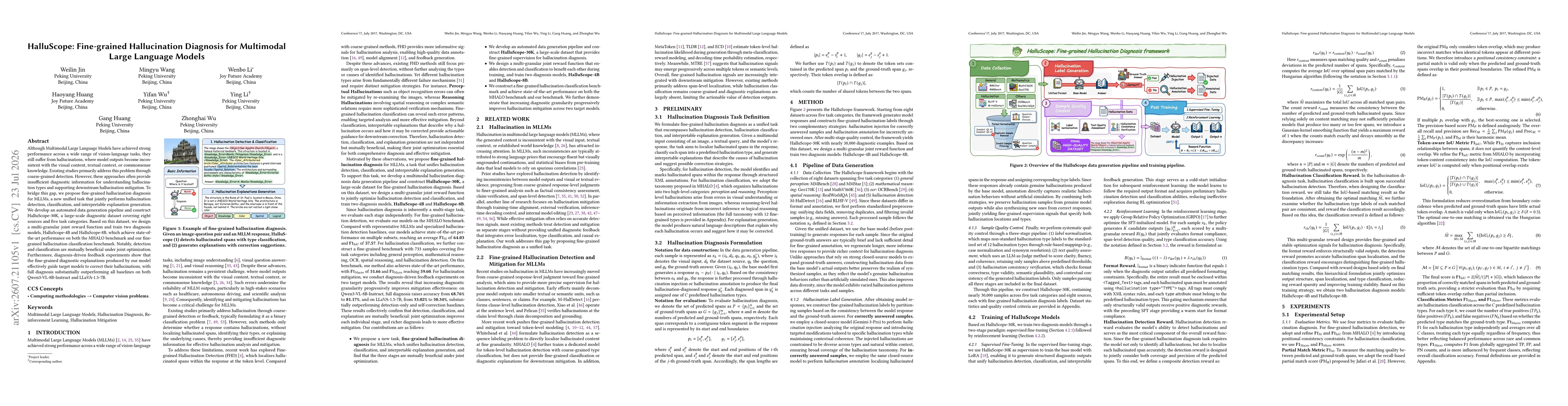
Although Multimodal Large Language Models have achieved strong performance across a wide range of vision-language tasks, they still suffer from hallucinations, where model outputs become inconsistent with the visual content, textual context, or commonsense knowledge. Existing studies primarily address this problem through coarse-grained detection. However, these approaches often provide insufficient diagnostic information for understanding hallucination types and supporting downstream hallucination mitigation. To bridge this gap, we propose fine-grained hallucination diagnosis for MLLMs, a new unified task that jointly performs hallucination detection, classification, and interpretable explanation generation. We develop an automated data generation pipeline and construct HalluScope-30K, a large-scale diagnostic dataset covering eight sources and five task categories. Based on this dataset, we design a multi-granular joint reward function and train two diagnosis models, HalluScope-4B and HalluScope-8B, which achieve state-of-the-art performance on both the MHALO benchmark and our fine-grained hallucination classification benchmark. Notably, detection and classification are mutually beneficial under joint optimization. Furthermore, diagnosis-driven feedback experiments show that the fine-grained diagnostic explanations produced by our model effectively guide target models to correct their hallucinations, with full diagnosis substantially outperforming all baselines on both Qwen3-VL-8B-Instruct and LLaVA-1.5-7B.
Analysis
AI-generated · verify against the original paper
Generated Jul 25, 2026ResultsWhat the authors found
- For detection, HalluScope models achieve state-of-the-art performance on the MHALO benchmark with average F1 of 64.03 and F1IoU of 57.57 across subsets.
- For fine-grained classification, the model reaches F1Macro of 51.66 and F1Micro of 59.60 on the constructed 733-sample benchmark across five categories.
- Diagnosis-driven feedback experiments show that full diagnosis substantially improves mitigation: on Qwen3-VL-8B-Instruct, accuracy rises from 68.76% to 81.17%; on LLaVA-1.5-7B, from 33.02% to 50.34%.
- Detection, classification, and explanation are mutually beneficial; richer diagnostic signals improve downstream mitigation and each stage benefits from joint optimization.
LimitationsWhere the findings need caution
- Evaluation focuses on benchmark suites and selected target models; generalization to broader model families or tasks not covered in HalluScope-30K remains to be demonstrated.
- Reliance on automated data generation may introduce biases or gaps in real-world hallucination patterns not captured in the dataset.
- The computational cost of training HalluScope-8B with multi-granular supervision may limit accessibility for some research teams.
MethodologyHow the work was done
HalluScope introduces a unified fine-grained hallucination diagnosis framework for Multimodal Large Language Models (MLLMs). It constructs HalluScope-30K via automated data generation to provide token- and span-level supervision across eight sources and five task categories. The approach jointly optimizes three stages: hallucination detection (span-level, with type classification), hallucination classification (five categories including general perception, mathematical reasoning, OCR, spatial reasoning, and hallucination detection), and interpretable explanation generation. A multi-granular joint reward function guides training of two diagnosis models, HalluScope-4B and HalluScope-8B, enabling end-to-end learning that benefits downstream hallucination mitigation. Evaluation spans MHALO for detection, a fine-grained classification benchmark, and diagnosis-driven feedback experiments on target models to assess mitigation effectiveness.
SignificanceWhy the work matters
The work provides a unified, fine-grained diagnostic framework that localizes hallucinations, classifies their types, and generates actionable, interpretable explanations to guide mitigation. It demonstrates that richer diagnostic granularity enhances downstream model correction and that detection, classification, and explanations synergistically improve overall reliability of MLLMs in vision-language tasks.
Technical contributionsWhat the work introduces
A unified task formulation for fine-grained hallucination diagnosis (detection, classification, and explanation) in MLLMs; a large-scale HalluScope-30K dataset for multi-granular supervision; two high-capacity diagnosis models (HalluScope-4B and HalluScope-8B) trained with a joint reward function; a fine-grained hallucination classification benchmark; and empirical demonstrations that diagnosis-driven feedback improves downstream hallucination mitigation.
NoveltyHow it differs from prior work
First to unify detection, fine-grained type classification, and interpretable explanations into a single diagnostic framework for MLLMs; introduces a comprehensive dataset and evaluation for multi-granular hallucination diagnosis; demonstrates that diagnosis-driven feedback yields substantial gains in mitigating hallucinations across multiple target models.
Future workQuestions that remain
- Expand HalluScope-30K with more diverse sources and real-world hallucination cases to improve generalization.
- Investigate lighter-weight versions of HalluScope models for efficient deployment in resource-constrained settings.
- Explore integrating the fine-grained diagnostics into interactive tools for real-time hallucination mitigation during inference.
Discussion 0