Hamiltonian Stabilization of the Two-Photon Dicke Model
Abstract
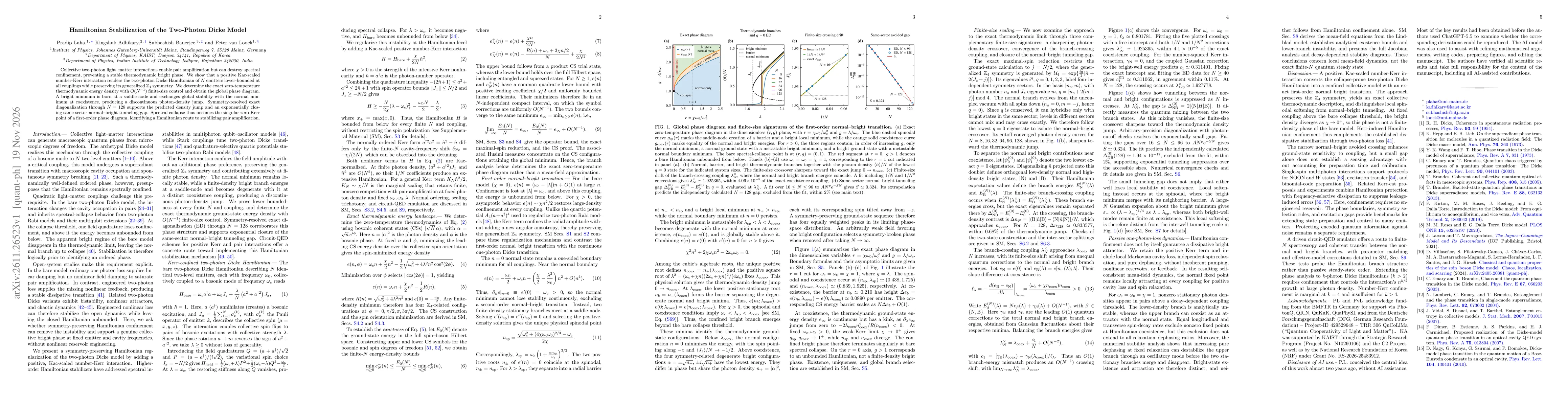
Collective two-photon light--matter interactions enable pair amplification but can destroy spectral confinement, preventing a stable thermodynamic bright phase. We show that a positive Kac-scaled number-Kerr interaction renders the two-photon Dicke Hamiltonian of \(N\) emitters lower-bounded at all couplings while preserving its generalized \(\mathbb Z_4\) symmetry. We determine the exact zero-temperature thermodynamic energy density with \(O(N^{-1})\) finite-size control and obtain the global phase diagram. A bright minimum is born at a saddle-node and exchanges global stability with the normal minimum at coexistence, producing a discontinuous photon-density jump. Symmetry-resolved exact diagonalization through \(N=128\) supports the predicted density jump and an exponentially closing same-sector normal--bright tunneling gap. Spectral collapse thus becomes the singular zero-Kerr point of a first-order phase diagram, identifying a Hamiltonian route to stabilizing pair amplification.
AI Key Findings — Failed
Key findings could not be generated. Please try again later.
Discussion 0