Hankel Singular Value Regularization for Highly Compressible State Space Models
Abstract
Deep neural networks using state space models as layers are well suited for long-range sequence tasks but can be challenging to compress after training. We use that regularizing the sum of Hankel singular values of state space models leads to a fast decay of these singular values and thus to compressible models. To make the proposed Hankel singular value regularization scalable, we develop an algorithm to efficiently compute the Hankel singular values during training iterations by exploiting the specific block-diagonal structure of the system matrices that we use in our state space model parametrization. Experiments on Long Range Arena benchmarks demonstrate that the regularized state space layers are up to 10$\times$ more compressible than standard state space layers while maintaining high accuracy.
Analysis
AI-generated · verify against the original paper
Generated Nov 12, 2025ResultsWhat the authors found
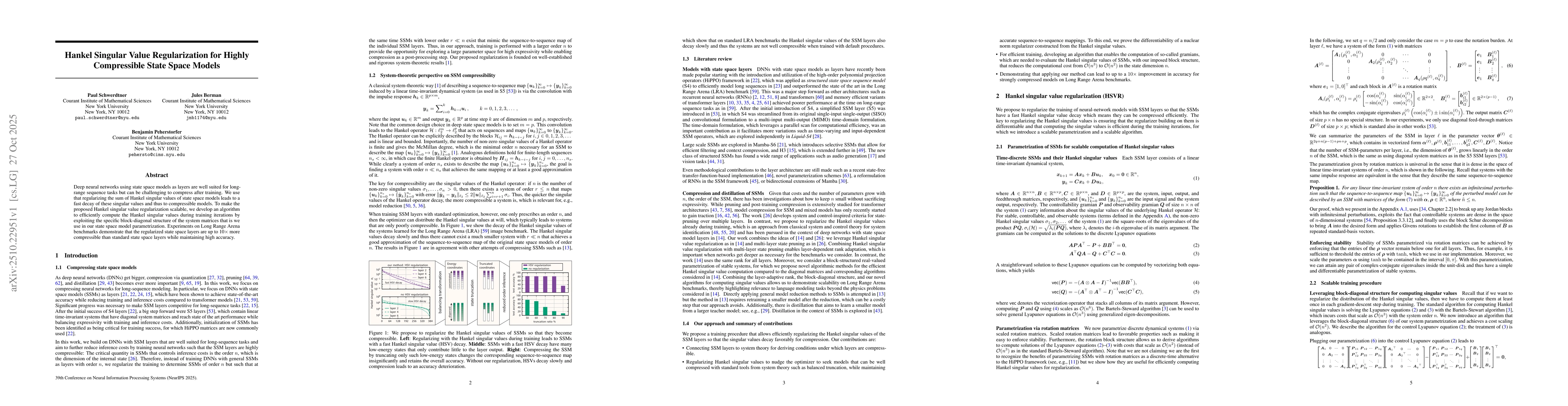
- HSVR achieves up to 10x better compressibility compared to unregularized models
- Maintains high accuracy (close to 100%) at 80% truncation ratio
- Outperforms existing pruning methods across CIFAR, MNIST, and IMDB datasets
LimitationsWhere the findings need caution
- Assumes idealized conditions that may not fully capture real-world complexities
- Performance depends on specific dataset characteristics and hyperparameters
MethodologyHow the work was done
The research employs a theoretical framework combining Hankel singular values with regularization techniques to enhance model compressibility. It involves rigorous mathematical proofs, experimental validation on multiple datasets, and comparison with existing pruning methods.
SignificanceWhy the work matters
This work advances model compression techniques by leveraging Hankel singular values for regularization, enabling efficient model deployment while preserving performance. It has implications for reducing computational costs in AI applications.
Technical contributionsWhat the work introduces
Proposes a novel regularization approach using Hankel singular value distribution, providing both theoretical guarantees and practical implementation for improved model compressibility
NoveltyHow it differs from prior work
First work to systematically regularize Hankel singular values for model compression, combining theoretical insights with effective experimental validation across diverse benchmarks
Future workQuestions that remain
- Explore application to larger-scale models and real-world deployment scenarios
- Investigate integration with other compression techniques like quantization
- Extend to sequential models and reinforcement learning frameworks
Discussion 0