HARP-Bench: Benchmarking Robot Manipulation Around Active Humans
Abstract
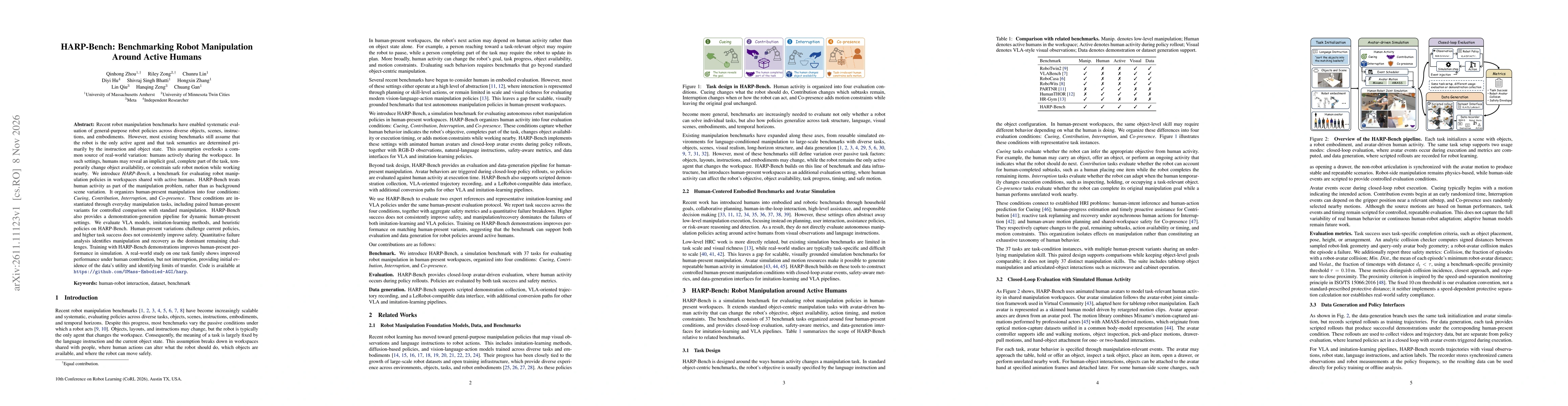
Recent robot manipulation benchmarks have enabled systematic evaluation of general-purpose robot policies across diverse objects, scenes, instructions, and embodiments. However, most existing benchmarks still assume that the robot is the only active agent and that task semantics are determined primarily by the instruction and object state. This assumption overlooks a common source of real-world variation: humans actively sharing the workspace. In such settings, humans may reveal an implicit goal, complete part of the task, temporarily change object availability, or constrain safe robot motion while working nearby. We introduce HARP-Bench, a benchmark for evaluating robot manipulation policies in workspaces shared with active humans. HARP-Bench treats human activity as part of the manipulation problem, rather than as background scene variation. It organizes human-present manipulation into four conditions: Cueing, Contribution, Interruption, and Co-presence. These conditions are instantiated through everyday manipulation tasks, including paired human-present variants for controlled comparison with standard manipulation. HARP-Bench also provides a demonstration-generation pipeline for dynamic human-present settings. We evaluate VLA models, imitation-learning methods, and heuristic policies on HARP-Bench. Human-present variations challenge current policies, and higher task success does not consistently improve safety. Quantitative failure analysis identifies manipulation and recovery as the dominant remaining challenges. Training with HARP-Bench demonstrations improves human-present performance in simulation. A real-world study on one task family shows improved performance under human contribution, but not interruption, providing initial evidence of the data's utility and identifying limits of transfer. Code is available at https://github.com/UMass-Embodied-AGI/harp.
AI Key Findings
Get AI-generated insights about this paper's methodology, results, significance, and more — available when analysis has been generated.
Discussion 0