HeadNeRF: A Real-time NeRF-based Parametric Head Model
HeadNeRF introduces a real-time NeRF-based parametric head model that leverages neural radiance fields for high fidelity, real-time rendering of human heads on GPUs, significantly reducing rendering time from 5s to 25ms through optimized 2D neural rendering and novel loss terms. This approach enables precise control over rendering pose and semantic attributes, while maintaining fine-level details.
Abstract
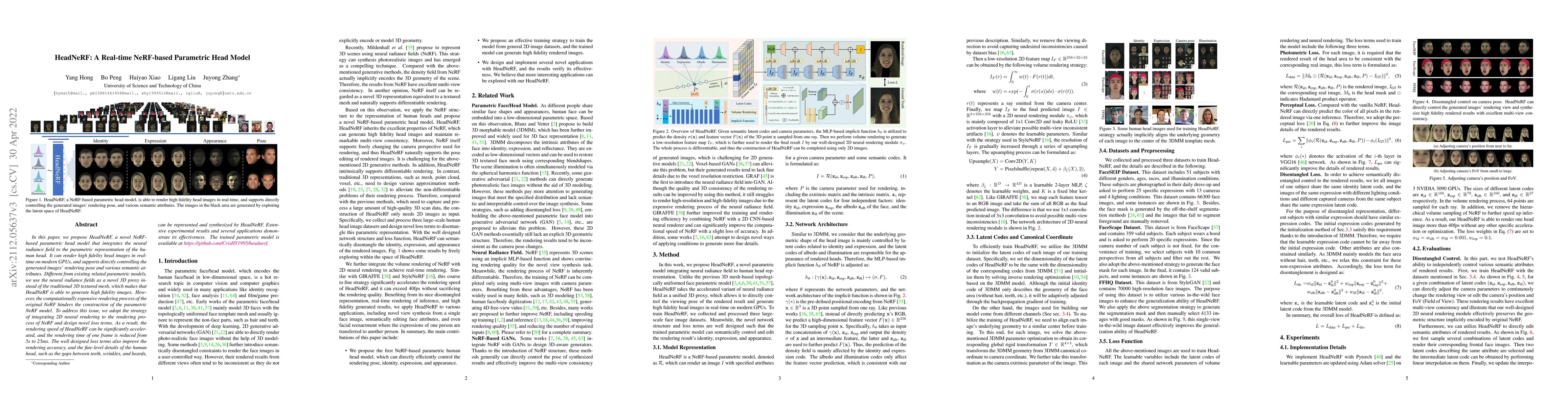
In this paper, we propose HeadNeRF, a novel NeRF-based parametric head model that integrates the neural radiance field to the parametric representation of the human head. It can render high fidelity head images in real-time on modern GPUs, and supports directly controlling the generated images' rendering pose and various semantic attributes. Different from existing related parametric models, we use the neural radiance fields as a novel 3D proxy instead of the traditional 3D textured mesh, which makes that HeadNeRF is able to generate high fidelity images. However, the computationally expensive rendering process of the original NeRF hinders the construction of the parametric NeRF model. To address this issue, we adopt the strategy of integrating 2D neural rendering to the rendering process of NeRF and design novel loss terms. As a result, the rendering speed of HeadNeRF can be significantly accelerated, and the rendering time of one frame is reduced from 5s to 25ms. The well designed loss terms also improve the rendering accuracy, and the fine-level details of the human head, such as the gaps between teeth, wrinkles, and beards, can be represented and synthesized by HeadNeRF. Extensive experimental results and several applications demonstrate its effectiveness. The trained parametric model is available at https://github.com/CrisHY1995/headnerf.
AI Key Findings
Get AI-generated insights about this paper's methodology, results, significance, and more — available when analysis has been generated.
Discussion 0