Hierarchical Semantic Learning for Multimodal Sentiment Analysis with Missing Modalities
Abstract
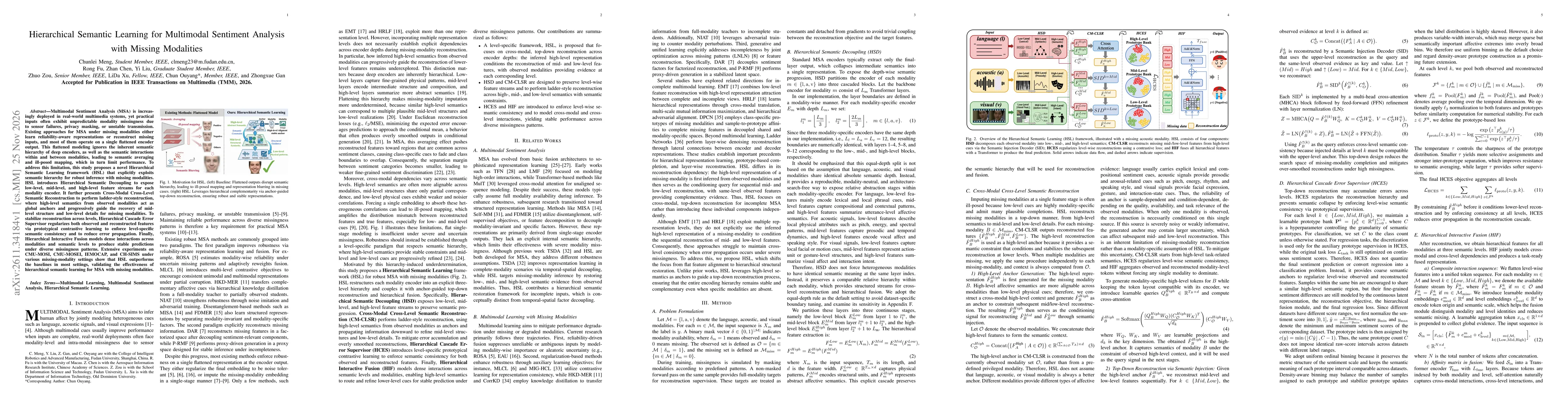
Multimodal sentiment analysis (MSA) in real-world systems must handle unpredictable modality missingness caused by sensor failures, privacy masking, and unstable transmission. Existing methods either learn reliability-aware representations or reconstruct missing inputs, often using a single flattened encoder output. This overlooks deep encoders' semantic hierarchy and intra- and inter-modal interactions, causing semantic averaging and ill-posed mappings. We propose Hierarchical Semantic Learning (HSL), a framework that exploits semantic hierarchy for robust MSA with missing modalities. Hierarchical Semantic Decoupling exposes low-, mid-, and high-level feature streams from each modality encoder. Cross-Modal Cross-Level Semantic Reconstruction performs ladder-style recovery, using high-level semantics from observed modalities as global anchors to progressively reconstruct mid-level structures and low-level details of missing modalities. To stabilize cross-level reconstruction, Hierarchical Cascade Error Supervisor applies prototypical contrastive regularization to observed and reconstructed features, enforcing level-specific semantic consistency and limiting error propagation. Finally, Hierarchical Interactive Fusion captures dense interactions across modalities and semantic levels to produce robust predictions under diverse missingness patterns. Experiments on CMU-MOSI, CMU-MOSEI, IEMOCAP, and CH-SIMS show that HSL outperforms baselines in most missing-modality settings.
Analysis
AI-generated · verify against the original paper
Generated Jan 1, 0001ResultsWhat the authors found
- Experiments on CMU‑MOSI, CMU‑MOSEI, IEMOCAP, and CH‑SIMS show that HSL outperforms baseline methods in most missing‑modality settings.
- Ablation studies confirm that each component (HSD, CM‑CLSR, HCES, HIF) contributes to consistent performance gains across datasets.
MethodologyHow the work was done
The proposed Hierarchical Semantic Learning (HSL) framework restructures each modality encoder into three hierarchical levels (low, mid, high) via Hierarchical Semantic Decoupling, performs ladder-style Cross-Modal Cross-Level Semantic Reconstruction using high‑level semantics from observed modalities as anchors to recover missing mid‑ and low‑level features, stabilizes reconstruction with a Hierarchical Cascade Error Supervisor that applies prototypical contrastive regularization, and finally integrates all levels and modalities through Hierarchical Interactive Fusion for sentiment prediction.
SignificanceWhy the work matters
HSL demonstrates that explicitly exploiting the semantic hierarchy of deep encoders and level‑specific cross‑modal reconstruction yields more robust multimodal sentiment analysis under unpredictable modality missingness, addressing a critical limitation of prior single‑flattened‑representation approaches.
Technical contributionsWhat the work introduces
Introduces a novel hierarchical decoupling and top‑down reconstruction paradigm that leverages high‑level semantic anchors and prototypical contrastive supervision to recover missing modality information across multiple semantic levels.
NoveltyHow it differs from prior work
First work to combine hierarchical semantic decoupling, cross‑modal cross‑level reconstruction, and level‑specific contrastive regularization within a unified framework for multimodal sentiment analysis with missing modalities.
Discussion 0