High-Fidelity Image Matting with Pixel-Space Diffusion Transformers
Abstract
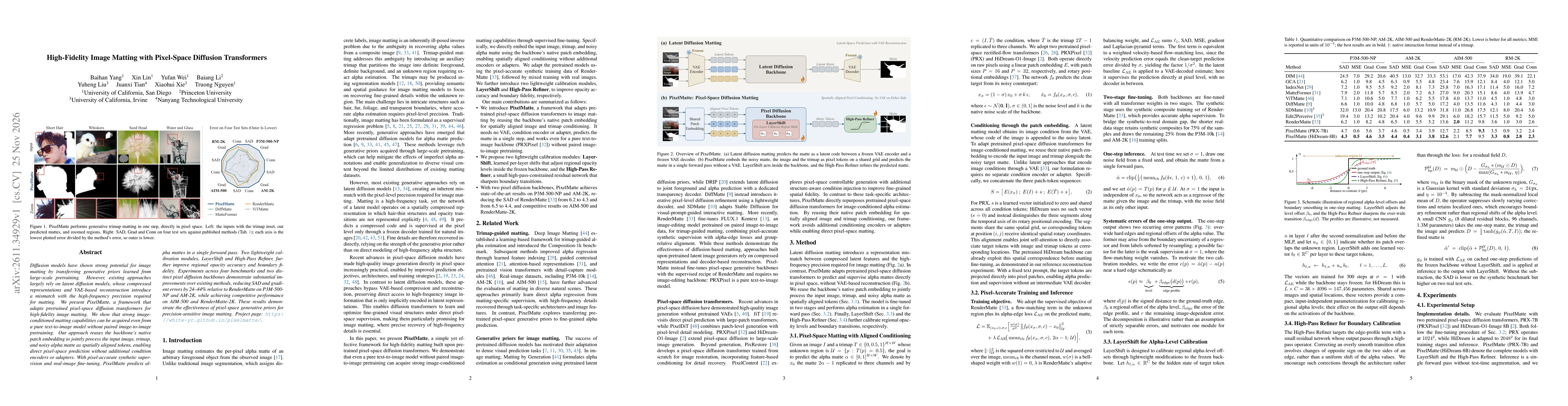
Diffusion models have shown strong potential for image matting by transferring generative priors learned from large-scale pretraining. However, existing approaches largely rely on latent diffusion models, whose compressed representations and VAE-based reconstruction introduce a mismatch with the high-frequency precision required for matting. We present PixelMatte, a framework that adapts pretrained pixel-space diffusion transformers for high-fidelity image matting. We show that strong image-conditioned matting capabilities can be acquired even from a pure text-to-image model without paired image-to-image pretraining. Our approach reuses the backbone's native patch embedding to jointly process the input image, trimap, and noisy alpha matte as spatially aligned tokens, enabling direct pixel-space prediction without additional condition encoders or adapters. With pixel-accurate synthetic supervision and real-image fine-tuning, PixelMatte predicts alpha mattes in a single forward pass. Two lightweight calibration modules, LayerShift and High-Pass Refiner, further improve regional opacity accuracy and boundary fidelity. Experiments across four benchmarks and two distinct pixel diffusion backbones demonstrate substantial improvements over existing methods, reducing SAD and gradient errors by 24-44% relative to RenderMatte on P3M-500-NP and AM-2K, while achieving competitive performance on AIM-500 and RenderMatte-2K. These results demonstrate the effectiveness of pixel-space generative priors for precision-sensitive image matting. Project page: https://white-yc.github.io/pixelmatte/.
Analysis
AI-generated · verify against the original paper
Generated Jan 1, 0001ResultsWhat the authors found
- Reduces SAD and gradient errors by 24–44% relative to RenderMatte on P3M-500-NP and AM-2K benchmarks.
- Achieves state-of-the-art SAD of 4.3 on P3M-500-NP and 4.4 on AM-2K, improving over RenderMatte's 6.2 and 6.5 respectively.
- Delivers competitive performance on AIM-500 and RenderMatte-2K while using a single forward pass.
MethodologyHow the work was done
PixelMatte adapts pretrained pixel-space diffusion transformers by reusing the backbone's native patch embedding to jointly process the input image, trimap, and noisy alpha matte as aligned tokens, enabling direct pixel-space prediction without additional condition encoders or adapters. It employs pixel-accurate synthetic supervision from Render-Matte and fine-tunes on real images, and introduces two lightweight calibration modules—LayerShift (learned per-layer opacity adjustments) and High-Pass Refiner (a high-pass constrained residual network) to improve regional opacity accuracy and boundary fidelity.
SignificanceWhy the work matters
Demonstrates that pixel-space generative priors from pretrained diffusion transformers can provide the high-frequency precision required for image matting, eliminating the need for latent representations and VAE decoders, and enabling efficient, high-fidelity matte prediction.
Technical contributionsWhat the work introduces
Introduces a framework that leverages pretrained pixel-space diffusion transformers for image matting without extra encoders, and adds two calibration modules (LayerShift and High-Pass Refiner) to enhance opacity and boundary quality, achieving state-of-the-art results across multiple benchmarks.
NoveltyHow it differs from prior work
First approach to adapt a pure text-to-image pixel diffusion model for trimap-guided matting without paired image-to-image pretraining, using direct token-level conditioning and lightweight calibration to attain high-fidelity alpha matte prediction.
Discussion 0