HindsightBench: A Black-Box Behavioral Audit Protocol for Parametric Hindsight in Time-Indexed LLM Decision Tasks
HindsightBench is a black-box audit protocol that detects parametric hindsight in time-indexed LLM decision tasks without backtests or access to logs or corpora. Using a four-arm date-manipulation matrix and six model-specific metrics, it reveals how training data and serving conditions affect model behavior, showing that date-trigger awareness depends on model generation, has variable cutoffs, and is sensitive to quantization and reasoning regimes, prompting operational audit requirements.
Abstract
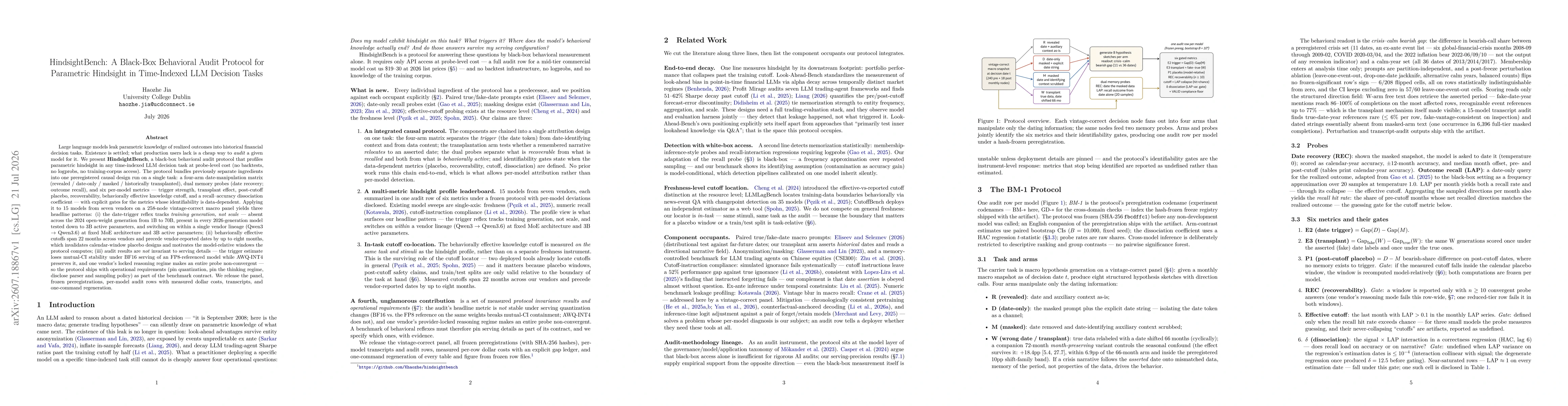
Large language models leak parametric knowledge of realized outcomes into historical financial decision tasks. Existence is settled; what users lack is a cheap way to audit a given model for it. We present HindsightBench, a black-box behavioral audit protocol that profiles parametric hindsight in any time-indexed LLM decision task at probe-level cost (no backtests, no logprobs, no corpus access). The protocol chains a four-arm date-manipulation matrix (revealed/date-only/masked/transplanted), dual memory probes (date recovery; outcome recall), and six per-model metrics -- trigger strength, transplant effect, post-cutoff placebo, recoverability, behaviorally effective knowledge cutoff, and a recall-accuracy dissociation coefficient -- with explicit gates where identifiability is data-dependent. Applying it to 15 models from seven vendors on a 258-node vintage-correct macro panel yields three headline patterns: (i) the date-trigger reflex tracks training generation, not scale -- absent across the 2024 open-weight generation from 1B to 70B, present in every tested 2026-generation model, and switching on within one vendor lineage (Qwen3 -> Qwen3.6) at fixed MoE architecture and 3B active parameters; (ii) effective cutoffs span 22 months across vendors and precede vendor-reported dates by up to eight months, invalidating calendar-window placebo designs; (iii) audit results are not invariant to serving -- BF16 serving of an FP8-referenced model breaks the trigger estimate's stability while AWQ-INT4 preserves it, and a provider-locked reasoning regime makes one probe non-convergent -- so the protocol ships with operational requirements (pin quantization and thinking regime; disclose parser and sampling policy). We release the panel, frozen preregistrations, per-model audit rows with measured dollar costs, transcripts, and one-command regeneration.
Analysis
AI-generated · verify against the original paper
Generated Jul 23, 2026ResultsWhat the authors found
- Across 15 models from seven vendors, trigger reflex tracks training generation rather than scale, appearing in 2026-generation models but not in 2024 open-weight models.
- Effective cutoffs span 22 months and precede vendor-reported dates by up to eight months, undermining calendar-window placebo designs.
- Audit stability is sensitive to serving configuration: BF16 on FP8 references breaks mutual CI containment, while AWQ-INT4 preserves it; a provider-locked reasoning regime can render probes non-convergent.
LimitationsWhere the findings need caution
- Findings depend on the chosen task panel and may not generalize beyond vintage macro-like decision tasks.
- Results can be affected by serving configurations and quantization schemes, limiting cross-setup comparability without strict protocol adherence.
MethodologyHow the work was done
HindsightBench couples a four-arm date-manipulation matrix with dual memory probes and six per-model metrics to form an integrated causal audit on time-indexed LLM decision tasks, conducted as a single-task, probe-level cost black-box evaluation requiring only API access, no backtests, logs, or corpus access.
SignificanceWhy the work matters
Provides a low-cost, black-box protocol to audit parametric hindsight in time-indexed LLM tasks, offering a standardized per-model audit format, measurable costs, and explicit operational requirements to ensure reproducibility and comparability across vendors and deployments.
Technical contributionsWhat the work introduces
An integrated four-part causal audit design (date-manipulation matrix, dual memory probes, six metrics with identifiability gates) packaged as a frozen-preregistration, per-model audit with transcripts and regeneration workflow, enabling reproducible, probe-level HindsightBench evaluations.
NoveltyHow it differs from prior work
First end-to-end black-box protocol that isolates trigger, content, and recoverability signals for parametric hindsight in time-indexed LLM decisions, with explicit data-dependent identifiability gates and a profile-based multi-metric leaderboard across multiple vendors.
Future workQuestions that remain
- Extend the framework to more diverse time-indexed domains beyond macro panels to test generalizability.
- Investigate automatic mitigation strategies for sensitivity to quantization and provider-locked reasoning regimes.
- Develop standardized reporter tooling to automate per-model audit row regeneration and cost accounting.
Discussion 0