Historical Parallels between, and Modal Realism underlying Einstein and Everett Relativities
Abstract
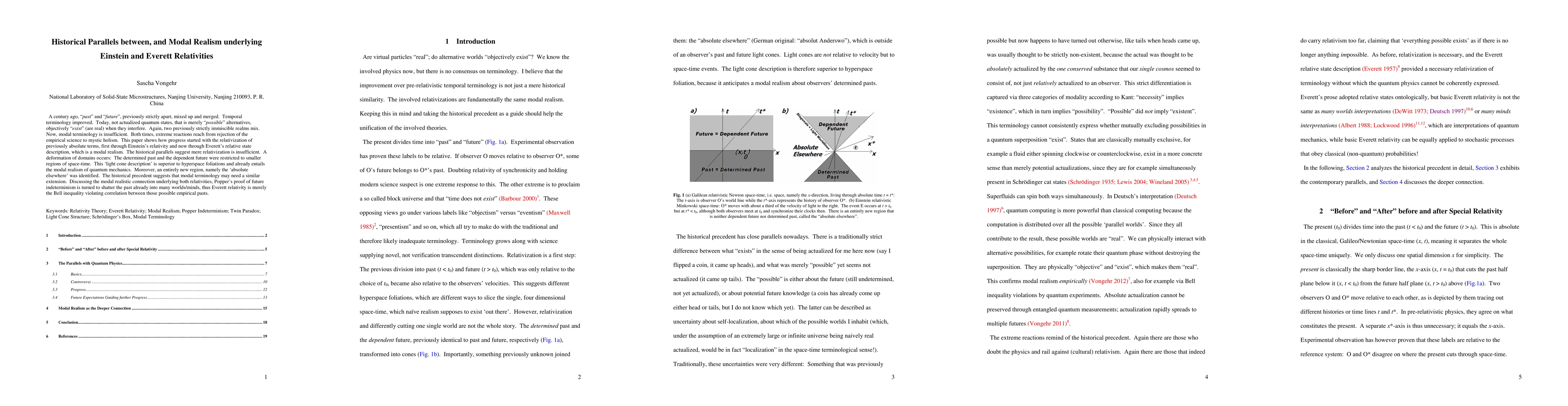
A century ago, "past" and "future", previously strictly apart, mixed up and merged. Temporal terminology improved. Today, not actualized quantum states, that is merely "possible" alternatives, objectively "exist" (are real) when they interfere. Again, two previously strictly immiscible realms mix. Now, modal terminology is insufficient. Both times, extreme reactions reach from rejection of the empirical science to mystic holism. This paper shows how progress started with the relativization of previously absolute terms, first through Einstein's relativity and now through Everett's relative state description, which is a modal realism. The historical parallels suggest mere relativization is insufficient. A deformation of domains occurs: The determined past and the dependent future were restricted to smaller regions of space-time. This light cone description is superior to hyperspace foliations and already entails the modal realism of quantum mechanics. Moreover, an entirely new region, namely the "absolute elsewhere" was identified. The historical precedent suggests that modal terminology may need a similar extension. Discussing the modal realistic connection underlying both relativities, Popper's proof of future indeterminism is turned to shatter the past already into many worlds/minds, thus Everett relativity is merely the Bell inequality violating correlation between possible empirical records.
AI Key Findings
Get AI-generated insights about this paper's methodology, results, significance, and more — available when analysis has been generated.
Discussion 0