How Far Can Linear Go? BiPert, a Unified Framework for Single-Cell Perturbation Modelling
Abstract
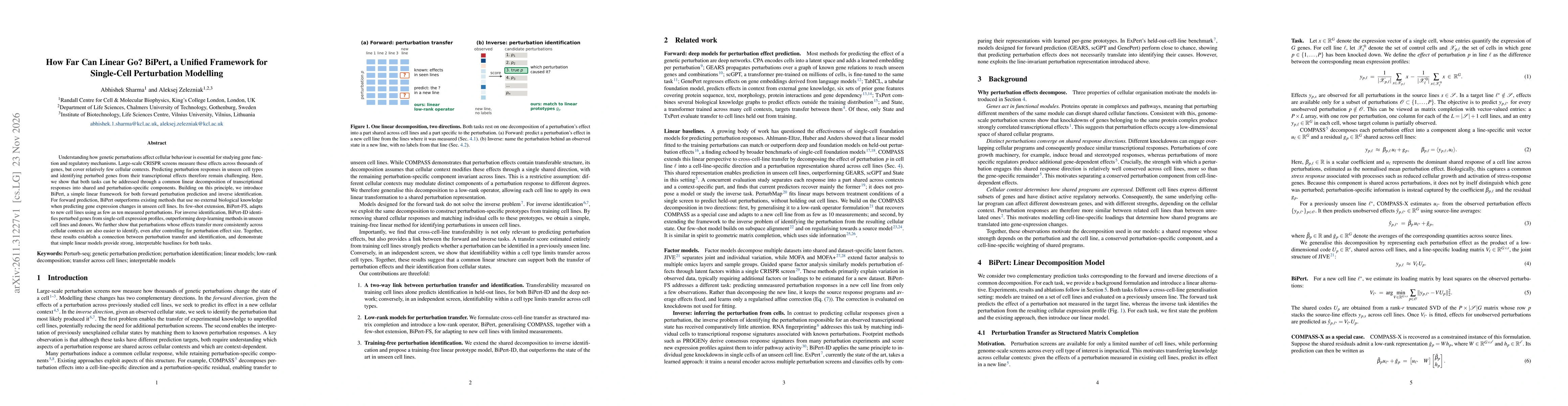
Understanding how genetic perturbations affect cellular behaviour is essential for studying gene function and regulatory mechanisms. Large-scale CRISPR screens measure these effects across thousands of genes, but cover relatively few cellular contexts. Predicting perturbation responses in unseen cell types and identifying perturbed genes from their transcriptional effects therefore remain challenging. Here, we show that both tasks can be addressed through a common linear decomposition of transcriptional responses into shared and perturbation-specific components. Building on this principle, we introduce BiPert, a simple linear framework for both forward perturbation prediction and inverse identification. For forward prediction, BiPert outperforms existing methods that use no external biological knowledge when predicting gene expression changes in unseen cell lines. Its few-shot extension, BiPert-FS, adapts to new cell lines using as few as ten measured perturbations. For inverse identification, BiPert-ID identifies perturbed genes from single-cell expression profiles, outperforming deep-learning methods in unseen cell lines and donors. We further show that perturbations whose effects transfer more consistently across cellular contexts are also easier to identify, even after controlling for perturbation effect size. Together, these results establish a connection between perturbation transfer and identification, and demonstrate that simple linear models provide strong, interpretable baselines for both tasks.
Analysis
AI-generated · verify against the original paper
Generated Jan 1, 0001ResultsWhat the authors found
- BiPert outperforms existing methods lacking external biological knowledge when predicting gene expression changes in unseen cell lines.
- The few-shot extension BiPert-FS can adapt to new cell lines using as few as ten measured perturbations.
- BiPert-ID identifies perturbed genes from single‑cell expression profiles better than deep‑learning methods in unseen cell lines and donors.
- Perturbations with higher cross‑cell transferability are easier to identify, and transfer scores predict identification beyond effect size alone.
LimitationsWhere the findings need caution
- The linear decomposition assumes that shared and perturbation‑specific components can capture all context‑dependent variation, which may be restrictive for highly non‑linear biological responses.
- Performance depends on the availability of at least a few measured perturbations for few‑shot adaptation.
MethodologyHow the work was done
BiPert uses a linear decomposition of transcriptional responses into shared and perturbation-specific components, employing a low-rank operator to model context-specific transformations; BiPert-FS extends this with few-shot adaptation, and BiPert-ID leverages the same decomposition for training-free perturbation identification.
SignificanceWhy the work matters
The work demonstrates that simple, interpretable linear models can serve as strong baselines for both forward perturbation prediction and inverse identification, linking transferability of perturbation effects to their identifiability across cellular contexts.
Technical contributionsWhat the work introduces
Introduction of a unified low‑rank linear framework (BiPert) that simultaneously addresses forward prediction and inverse identification, along with a few‑shot adaptation variant (BiPert-FS) and a training‑free identification method (BiPert-ID).
NoveltyHow it differs from prior work
First demonstration that a common linear decomposition can jointly solve forward perturbation prediction and inverse identification, and that transferability metrics derived from this model predict identification performance.
Discussion 0