HRT1: One-Shot Human-to-Robot Trajectory Transfer for Mobile Manipulation
Abstract
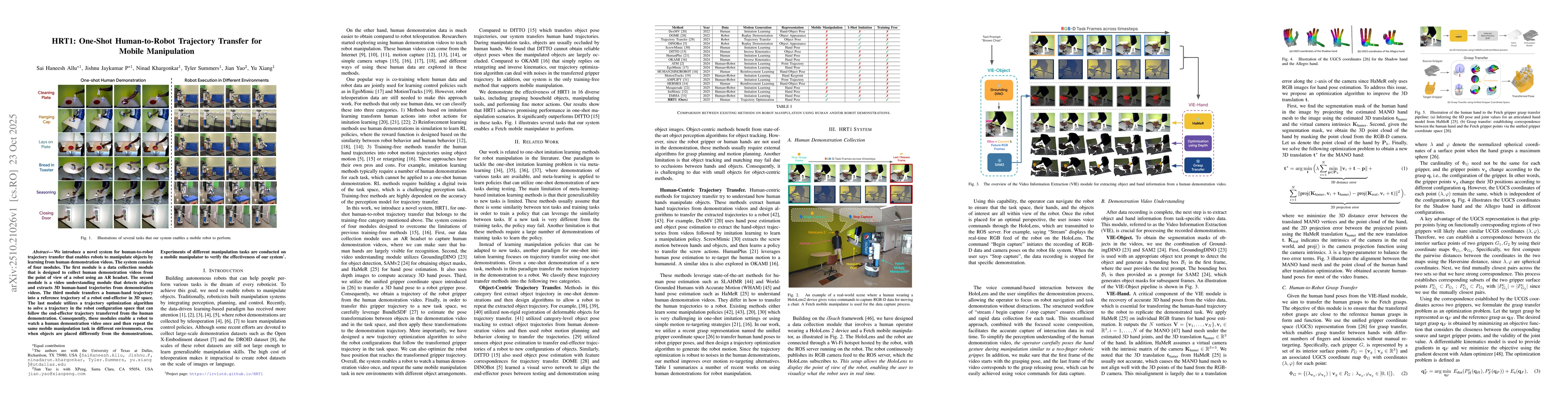
We introduce a novel system for human-to-robot trajectory transfer that enables robots to manipulate objects by learning from human demonstration videos. The system consists of four modules. The first module is a data collection module that is designed to collect human demonstration videos from the point of view of a robot using an AR headset. The second module is a video understanding module that detects objects and extracts 3D human-hand trajectories from demonstration videos. The third module transfers a human-hand trajectory into a reference trajectory of a robot end-effector in 3D space. The last module utilizes a trajectory optimization algorithm to solve a trajectory in the robot configuration space that can follow the end-effector trajectory transferred from the human demonstration. Consequently, these modules enable a robot to watch a human demonstration video once and then repeat the same mobile manipulation task in different environments, even when objects are placed differently from the demonstrations. Experiments of different manipulation tasks are conducted on a mobile manipulator to verify the effectiveness of our system
Analysis
AI-generated · verify against the original paper
Generated Nov 15, 2025ResultsWhat the authors found
- HRT1 enables a mobile manipulation robot to imitate human demonstrations directly from RGB-D videos without task-specific training
- The two-stage optimization process maintains low tracking errors across all tasks with average rotational error of 0.1192 radians and translational error of 0.0038 meters
- Real-world experiments across 16 diverse tasks validate the effectiveness of the approach
LimitationsWhere the findings need caution
- Success relies heavily on object pose estimation which can be error-prone under challenging conditions
- The trajectory optimization runtime depends on the length of the human demonstration trajectory
MethodologyHow the work was done
The research introduces HRT1, a training-free framework for one-shot human-to-robot trajectory transfer in mobile manipulation. It leverages 3D human hand pose estimation and grasp transfer to generate robust robot end-effector trajectories. A two-stage optimization process is used to solve for optimal base positioning and precise end-effector trajectory tracking.
SignificanceWhy the work matters
This research advances human-robot interaction by enabling direct trajectory transfer from human demonstrations, reducing the need for complex training processes. It has potential applications in service robotics, industrial automation, and assistive technologies.
Technical contributionsWhat the work introduces
The two-stage optimization algorithm for precise end-effector trajectory tracking and optimal base positioning in real-world task execution
NoveltyHow it differs from prior work
Combines 3D hand pose estimation with grasp transfer for robust trajectory generation, along with a two-stage optimization process that enables accurate one-shot human-to-robot trajectory transfer without task-specific training
Future workQuestions that remain
- Improve object pose estimation using advanced depth sensing techniques like FoundationStereo or DinoV3 features
- Develop a closed-loop mobile manipulation system that adapts to errors in object pose estimation and robot base motion
Discussion 0