Abstract
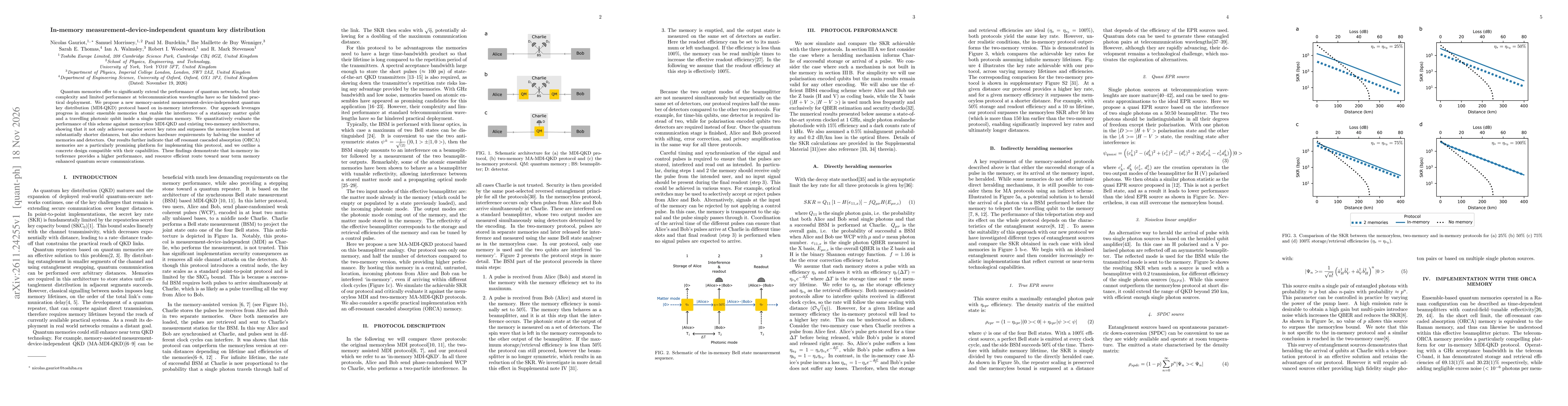
Quantum memories offer to significantly extend the performance of quantum networks, but their complexity and limited performance at telecommunication wavelengths have so far hindered practical deployment. We propose a new memory-assisted measurement device independent quantum key distribution (MDI-QKD) protocol based on in-memory interference. Our approach leverages progress in atomic ensemble memories that enable the interference of a stationary matter qubit and a travelling photonic qubit inside a single quantum memory. We quantitatively evaluate the performance of this scheme against memoryless MDI-QKD and existing two-memory architectures, showing that it not only achieves superior secret key rates and surpasses the memoryless bound at substantially shorter distances, but also reduces hardware requirements by halving the number of memories and detectors. Our results further indicate that off resonant cascaded absorption (ORCA) memories are a particularly promising platform for implementing this protocol, and we outline a concrete design compatible with their capabilities. These findings demonstrate that in-memory interference provides a higher performance, and resource efficient route toward near term memory enhanced quantum secure communications.
Analysis
AI-generated · verify against the original paper
Generated Jan 1, 0001ResultsWhat the authors found
- The in‑memory MDI‑QKD scheme achieves superior secret key rates compared to both memoryless MDI‑QKD and existing two‑memory protocols.
- It surpasses the memoryless secret‑key capacity bound at substantially shorter distances.
- The protocol reduces hardware requirements by halving the number of quantum memories and detectors needed.
- Off‑resonant cascaded absorption (ORCA) memories are identified as a particularly promising platform for implementation.
LimitationsWhere the findings need caution
- The protocol’s secret‑key rate degrades if the maximum storage/retrieval efficiency falls below 50%, as the effective beamsplitter becomes asymmetric.
- Successful operation requires memories with large time‑bandwidth products to store short (≈100 ps) pulses without reducing transmitter repetition rates.
MethodologyHow the work was done
The paper proposes a memory‑assisted measurement‑device‑independent QKD (MA‑MDI‑QKD) protocol that uses a single atomic‑ensemble quantum memory as an effective beamsplitter to interfere a stored matter qubit with a travelling photonic qubit (‘in‑memory interference’). The protocol stores Alice’s pulse, then Bob’s pulse, and exploits the memory’s storage/retrieval efficiency to create interference inside the memory before measurement, halving the number of memories and detectors compared to the two‑memory architecture.
SignificanceWhy the work matters
The work demonstrates that in‑memory interference provides a higher‑performance, resource‑efficient pathway toward near‑term memory‑enhanced quantum secure communications, potentially accelerating practical deployment of quantum repeaters and long‑distance QKD.
Technical contributionsWhat the work introduces
Introduction of a novel MA‑MDI‑QKD protocol that leverages a single quantum memory as an effective beamsplitter for in‑memory interference, enabling interference of stored and travelling qubits and reducing the number of required memories and detectors.
NoveltyHow it differs from prior work
First demonstration of measurement‑device‑independent QKD using in‑memory interference with a single quantum memory, achieving higher key rates and lower hardware complexity than prior memory‑assisted or memoryless schemes.
Future workQuestions that remain
- Develop and experimentally test the concrete ORCA‑memory design compatible with the protocol’s requirements.
- Optimize memory parameters (efficiency, bandwidth, lifetime) to further improve key rates and distance.
- Explore integration of the in‑memory scheme into larger quantum network architectures and repeaters.
Discussion 0