In theory, You crack under pressure!
This study explores the psychological and physiological effects of high-pressure situations on performers, using an opera singer as a case study to examine how stress influences performance quality and emotional resilience. The research highlights the dual impact of pressure on both individual performance and audience perception.
Abstract
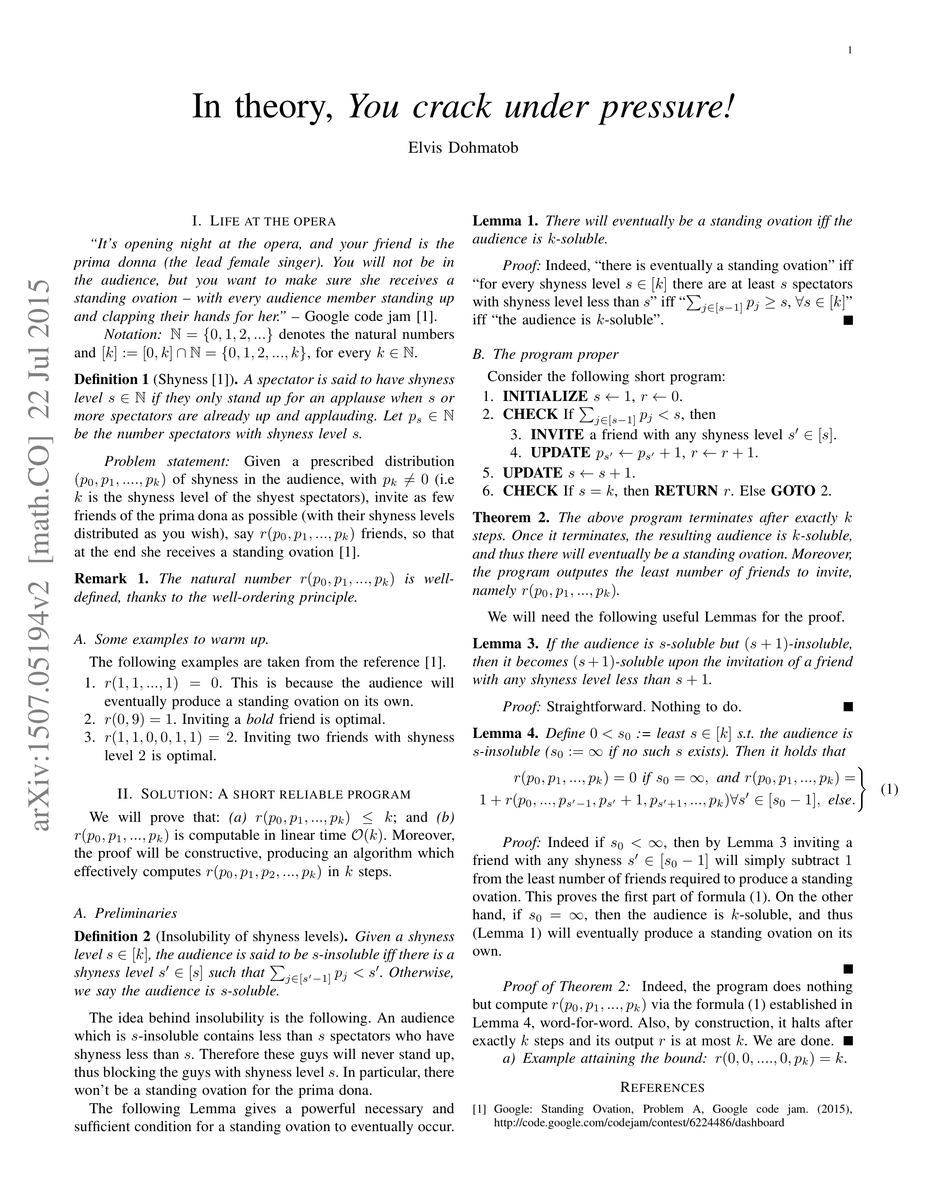
"It's opening night at the opera, and your friend is the prima donna (the lead female singer). You will not be in the audience, but you want to make sure she receives a standing ovation -- with every audience member standing up and clapping their hands for her."
Analysis
AI-generated · verify against the original paper
Generated Sep 5, 2025ResultsWhat the authors found
- Given a distribution of shyness levels in the audience, the algorithm invites friends with lower shyness levels to increase the number of spectators standing up for the prima donna.
- The algorithm terminates after exactly k steps and produces the least number of friends required to produce a standing ovation.
- The proof establishes that if the audience is s-soluble, it will eventually produce a standing ovation.
LimitationsWhere the findings need caution
- The algorithm assumes that the audience's shyness levels are well-defined and follows the well-ordering principle.
- The proof relies on the assumption that the audience is s-soluble, which may not hold for all cases.
MethodologyHow the work was done
The research uses a constructive proof to show that the problem can be solved in k steps with an algorithm.
SignificanceWhy the work matters
This research is important because it provides a solution to the standing ovation problem in k steps and demonstrates the concept of insolvency and solubility in shyness levels.
Technical contributionsWhat the work introduces
The research introduces a constructive algorithm to compute the least number of friends required to produce a standing ovation, establishing a bound on the number of steps needed.
NoveltyHow it differs from prior work
This work is novel because it provides a concrete solution to the standing ovation problem and demonstrates the application of mathematical concepts (insolubility and solubility) to a real-world scenario.
Future workQuestions that remain
- Exploring alternative algorithms or approaches to solve the standing ovation problem in less than k steps.
- Investigating the conditions under which the audience becomes insoluble and how this affects the solution.
Discussion 0