This paper introduces the Consecutive Batch DropBlock Network (CBDB-Net) for person re-identification, featuring the Consecutive Batch DropBlock Module (CBDBM) and Elastic Loss (EL) to enhance robust descriptor mining. CBDB-Net achieves competitive performance across multiple datasets, demonstrating the effectiveness of its novel training strategies.
Abstract
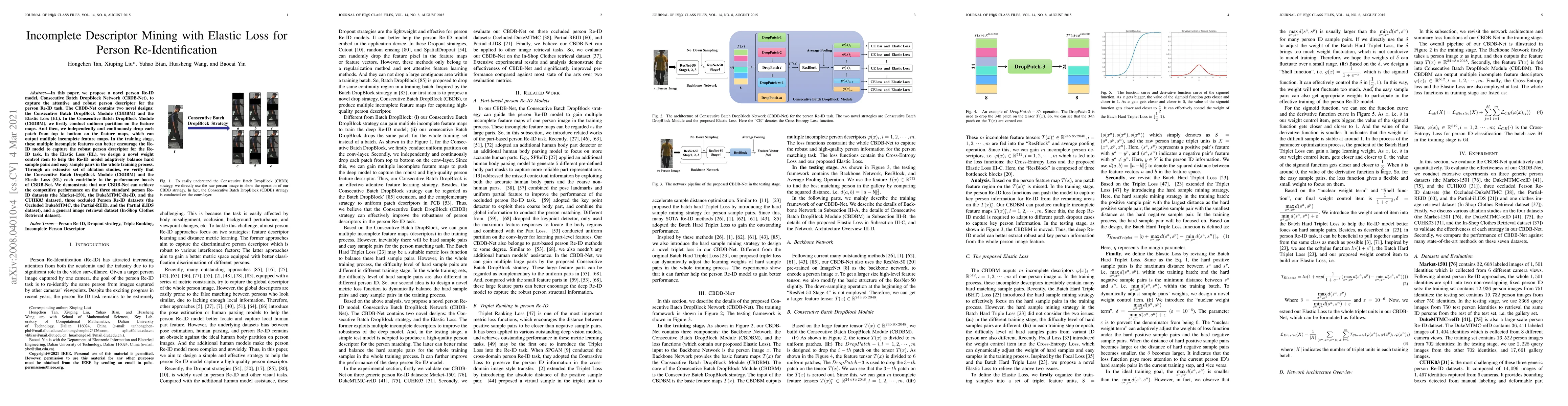
In this paper, we propose a novel person Re-ID model, Consecutive Batch DropBlock Network (CBDB-Net), to capture the attentive and robust person descriptor for the person Re-ID task. The CBDB-Net contains two novel designs: the Consecutive Batch DropBlock Module (CBDBM) and the Elastic Loss (EL). In the Consecutive Batch DropBlock Module (CBDBM), we firstly conduct uniform partition on the feature maps. And then, we independently and continuously drop each patch from top to bottom on the feature maps, which can output multiple incomplete feature maps. In the training stage, these multiple incomplete features can better encourage the Re-ID model to capture the robust person descriptor for the Re-ID task. In the Elastic Loss (EL), we design a novel weight control item to help the Re-ID model adaptively balance hard sample pairs and easy sample pairs in the whole training process. Through an extensive set of ablation studies, we verify that the Consecutive Batch DropBlock Module (CBDBM) and the Elastic Loss (EL) each contribute to the performance boosts of CBDB-Net. We demonstrate that our CBDB-Net can achieve the competitive performance on the three standard person Re-ID datasets (the Market-1501, the DukeMTMC-Re-ID, and the CUHK03 dataset), three occluded Person Re-ID datasets (the Occluded DukeMTMC, the Partial-REID, and the Partial iLIDS dataset), and a general image retrieval dataset (In-Shop Clothes Retrieval dataset).
AI Key Findings
Get AI-generated insights about this paper's methodology, results, significance, and more — available when analysis has been generated.
Discussion 0