Initial Conditions and Wave-Phase Resolution for Scalar-Field Dark Matter Simulations
Abstract
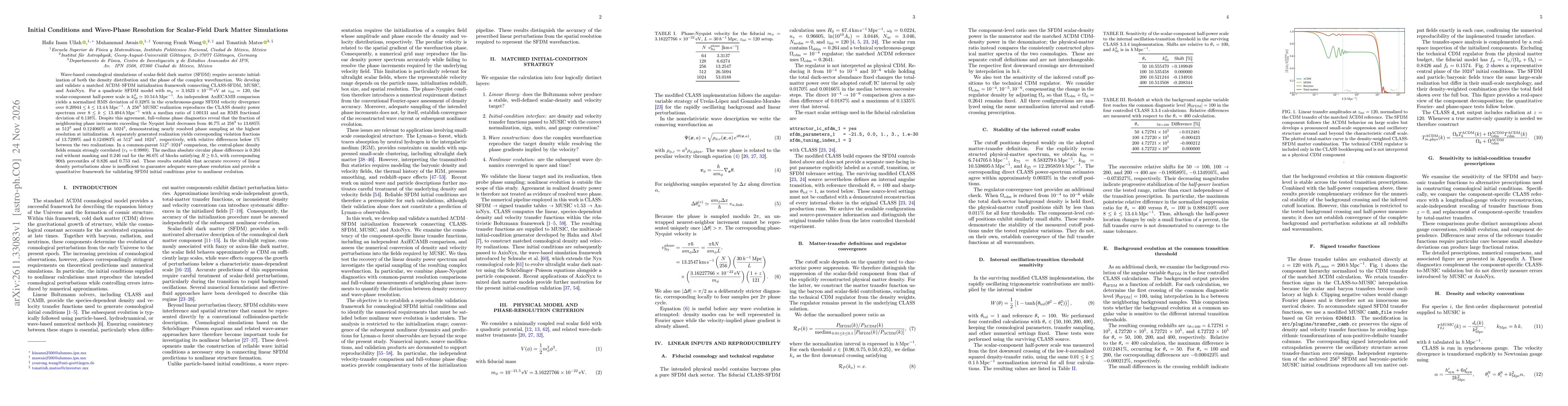
Wave-based cosmological simulations of scalar-field dark matter (SFDM) require accurate initialization of both density and complex-wavefunction phase. We develop and validate a matched $Λ$CDM--SFDM initialization framework connecting CLASS-SFDM, MUSIC, and AxioNyx. For quadratic SFDM with $m_φ=3.1623\times10^{-22}\,\mathrm{eV}$ at $z_{\rm ini}=120$, the scalar-component half-power scale is $k_{50}^φ\simeq10.54\,h\,\mathrm{Mpc}^{-1}$. An independent AxiECAMB comparison gives a normalized RMS deviation of $0.328\%$ in the synchronous-gauge SFDM velocity divergence over $0.20944\leq k\leq13.4\,h\,\mathrm{Mpc}^{-1}$. A $256^3$ MUSIC realization reproduces the CLASS density power spectrum over $8\leq k\leq13.404\,h\,\mathrm{Mpc}^{-1}$ with a median ratio of $1.00131$ and an RMS fractional deviation of $0.138\%$. Despite this agreement, full-volume phase diagnostics show that the fraction of velocity-implied phase increments violating the Nyquist criterion decreases from $46.7\%$ at $256^3$ to $13.685\%$ at $512^3$ and $0.124060\%$ at $1024^3$. A separately generated realization yields $13.7299\%$ and $0.124983\%$ at $512^3$ and $1024^3$, respectively, with relative differences below $1\%$. In a common-parent $512^3$--$1024^3$ comparison, the central-plane density fields remain strongly correlated ($r_δ=0.9989$). The median absolute circular phase difference is $0.264$ rad without masking and $0.246$ rad for $86.6\%$ of blocks satisfying $R\geq0.5$, with 90th percentiles $0.826$ and $0.753$ rad. These results demonstrate that accurate linear density recovery does not guarantee adequate wave-phase resolution and provide validation criteria for SFDM initial conditions prior to nonlinear evolution.
AI Key Findings
Get AI-generated insights about this paper's methodology, results, significance, and more — available when analysis has been generated.
Discussion 0