Integral DeltaNet: Improved Linear Attention with Adaptive Memory Integration
Abstract
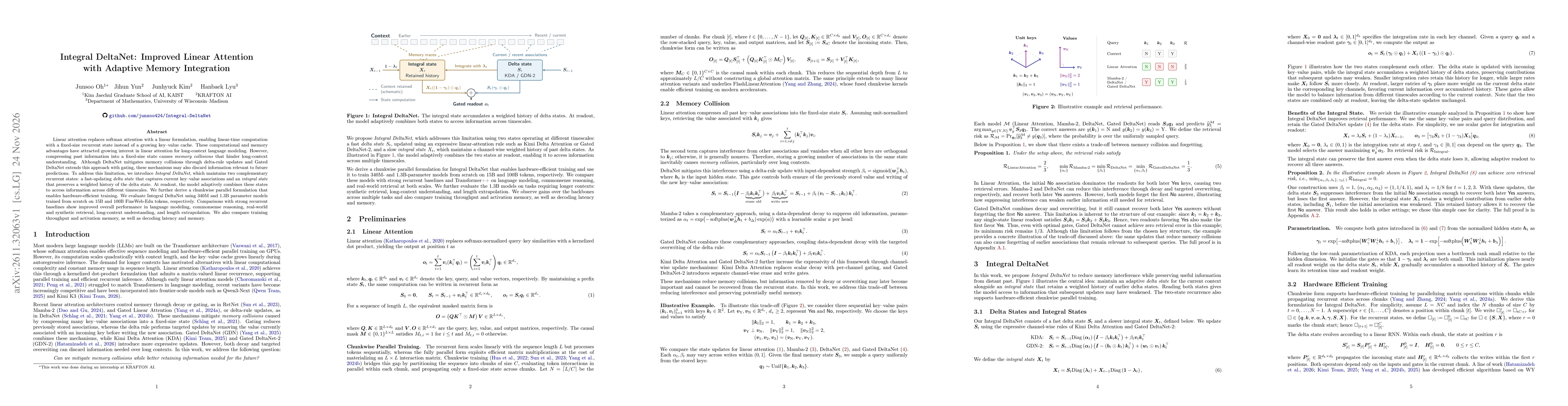
Linear attention replaces softmax attention with a linear formulation, enabling linear-time computation with a fixed-size recurrent state instead of a growing key-value cache. These computational and memory advantages have attracted growing interest in linear attention for long-context language modeling. However, compressing past information into a fixed-size state causes memory collisions that hinder long-context understanding. Although DeltaNet mitigates memory collisions through delta-rule updates and Gated DeltaNet extends this approach with gating, these mechanisms may also discard information relevant to future predictions. To address this limitation, we introduce Integral DeltaNet, which maintains two complementary recurrent states: a fast-updating delta state that captures current key-value associations and an integral state that preserves a weighted history of the delta state. At readout, the model adaptively combines these states to access information across different timescales. We further derive a chunkwise parallel formulation that enables hardware-efficient training. We evaluate Integral DeltaNet using 340M and 1.3B parameter models trained from scratch on 15B and 100B FineWeb-Edu tokens, respectively. Comparisons with strong recurrent baselines show improved overall performance in language modeling, commonsense reasoning, real-world and synthetic retrieval, long-context understanding, and length extrapolation. We also compare training throughput and activation memory, as well as decoding latency and memory.
Analysis
AI-generated · verify against the original paper
Generated Jan 1, 0001ResultsWhat the authors found
- Integral DeltaNet outperforms strong recurrent baselines on language modeling, commonsense reasoning, real‑world and synthetic retrieval, long‑context understanding, and length extrapolation across both model scales.
- Ablation studies show that the integral state, input‑dependent readout, and channel‑wise gating each contribute to lower perplexity and higher commonsense accuracy, with the full model achieving the best overall performance.
- Chunkwise parallel training enables efficient training throughput and reduced activation memory while maintaining competitive decoding latency and memory usage.
MethodologyHow the work was done
Integral DeltaNet introduces two complementary recurrent states—a fast-updating delta state and a slower integral state that accumulates a weighted history of the delta state. An input-dependent readout adaptively combines these states at each timestep. The model is trained using a chunkwise parallel formulation that enables hardware-efficient training, and evaluated on 340M and 1.3B parameter models trained from scratch on 15B and 100B FineWeb‑Edu tokens respectively.
SignificanceWhy the work matters
The work demonstrates that maintaining a separate integral memory alongside a delta‑update state mitigates memory collisions and preserves long‑range information, advancing linear‑attention models toward practical long‑context language modeling with constant memory overhead.
Technical contributionsWhat the work introduces
A dual‑state recurrent architecture that integrates a fast delta update with a slow integral memory, combined via an adaptive readout, and a chunkwise parallel training scheme for efficient large‑scale training.
NoveltyHow it differs from prior work
Introducing an integral state that accumulates weighted histories of delta states and adaptively fusing it with the delta state, enabling multi‑timescale memory access in linear attention models.
Discussion 0