Intersecting families and nonvanishing multivariate polynomials over finite fields
The paper classifies the largest intersecting families of degree-d polynomials over finite fields in n variables, showing that for odd q the maximal families are always stars (f(a)=b) when d≥2, for any n≥2. For even q, non-star maximal examples appear precisely when d≤n and q≥4; the work also determines the span of nonvanishing polynomials and characterizes linear functionals whose kernels avoid nonvanishing polynomials, yielding a finite-field Gleason–Kahane–Żelazko-type result.
Abstract
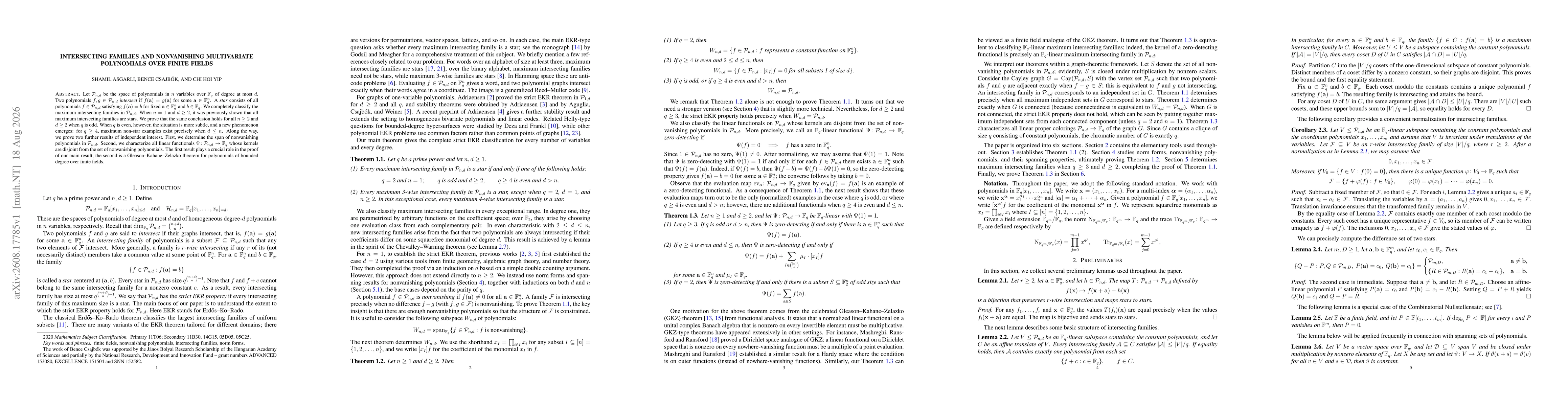
Let $\mathcal{P}_{n,d}$ be the space of polynomials in $n$ variables over $\mathbb{F}_q$ of degree at most $d$. Two polynomials $f,g\in\mathcal{P}_{n,d}$ intersect if $f(\mathbf a)=g(\mathbf a)$ for some $\mathbf a\in\mathbb{F}_q^n$. A star consists of all polynomials $f\in\mathcal{P}_{n,d}$ satisfying $f(\mathbf a)=b$ for fixed $\mathbf a\in\mathbb{F}_q^n$ and $b\in\mathbb{F}_q$. We completely classify the maximum intersecting families in $\mathcal{P}_{n,d}$. When $n=1$ and $d\geq 2$, it was previously shown that all maximum intersecting families are stars. We prove that the same conclusion holds for all $n\geq 2$ and $d\geq 2$ when $q$ is odd. When $q$ is even, however, the situation is more subtle, and a new phenomenon emerges: for $q\geq 4$, maximum non-star examples exist precisely when $d\leq n$. Along the way, we prove two further results of independent interest. First, we determine the span of nonvanishing polynomials in $\mathcal{P}_{n,d}$. Second, we characterize all linear functionals $Ψ\colon\mathcal{P}_{n,d}\to\mathbb{F}_q$ whose kernels are disjoint from the set of nonvanishing polynomials. The first result plays a crucial role in the proof of our main result; the second is a Gleason--Kahane--Żelazko theorem for polynomials of bounded degree over finite fields.
Analysis
AI-generated · verify against the original paper
Generated Aug 20, 2026ResultsWhat the authors found
- Complete strict EKR classification: every maximum intersecting family inPn,d is a star if q=2 with n=1; q is odd with d≥2; or q≥4 even with d>n.
- New non-star phenomena in even characteristic: for q≥4, maximum non-star examples exist precisely when d≤n.
- Span of nonvanishing polynomials determined: precisely characterizes the subspaceWn,d relevant to the extremal structure.
- Gleason–Kahane–Żelazko-type result for bounded-degree polynomials: all linear functionals whose kernels avoid nonvanishing polynomials are classified.
LimitationsWhere the findings need caution
- Results rely on detailed case distinctions by parity of q and relative size of d and n, which may complicate direct applicability to related combinatorial polynomial settings.
- The non-star constructions in even characteristic are described but may require further explicit constructions for broader parameter regimes.
- The linear functional classification is proven in the polynomial-bounded-degree setting; extensions to higher degrees or different coefficient rings are not addressed.
MethodologyHow the work was done
The authors employ a combination of algebraic and combinatorial techniques, leveraging span and nonvanishing subspaces of polynomials, induction on degree and dimension, and constraints from Chevalley–Warning-type arguments to classify maximum intersecting families inPn,d. They introduce and analyze the subspaceWn,d generated by nonvanishing polynomials, and develop a Gleason–Kahane–Żelazko-type characterization for linear functionals onPn,d whose kernels avoid nonvanishing polynomials.
SignificanceWhy the work matters
The work delivers a complete EKR-type classification for multivariate polynomials over finite fields across all n and d, clarifying how characteristic interacts with extremal intersecting families and connecting structural polynomial spans to extremal set families; it also provides a new functional-analytic perspective for polynomials of bounded degree over finite fields.
Technical contributionsWhat the work introduces
Introduction of theWn,d subspace to capture nonvanishing polynomials, a complete inductive framework across n and d for the strict EKR property, and a Gleason–Kahane–Żelazko-type theorem tailored to bounded-degree polynomials over finite fields.
NoveltyHow it differs from prior work
First complete strict EKR classification for multivariate polynomials over finite fields across all dimensions and degrees, plus new phenomena in even characteristic and a novel functional-analytic perspective via the nonvanishing-span and kernel-characterization results.
Future workQuestions that remain
- Extend explicit constructions of maximum non-star families for q even beyond the d≤n regime.
- Explore analogous classifications for related polynomial families or alternative function spaces over finite fields.
- Apply the Wn,d-span results to refine stability analyses and potential algorithmic applications in coding theory and finite-field geometry.
Discussion 0