Intersections of Odd Polygons Revisited
Abstract
It is shown that the maximum number of intersection points between the boundaries of a simple $m$-gon and a simple $n$-gon is $mn-(m+n)+3$ for any odd integers $m,n \ge 3$. The previous best upper bound was $mn-(m+n)+C$, for some huge constant $C$.
Analysis
AI-generated · verify against the original paper
Generated Jan 1, 0001ResultsWhat the authors found
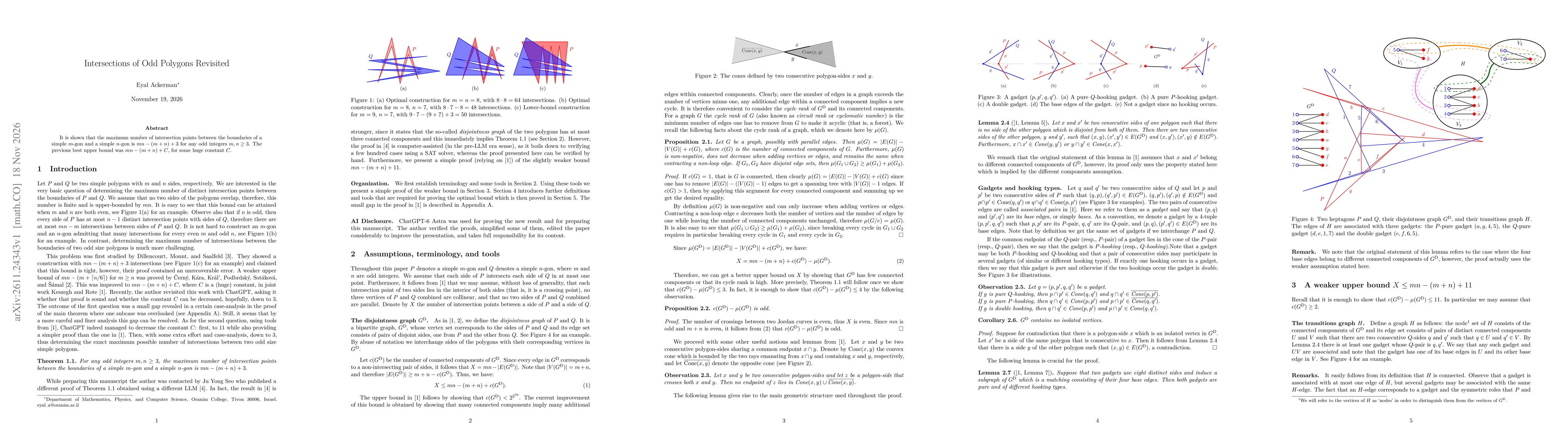
- For any odd integers m,n ≥ 3, the maximum number of intersection points between a simple m‑gon and a simple n‑gon is mn − (m + n) + 3.
- The previous upper bound with a huge constant C is reduced first to +11 and then to the exact +3.
- A simpler hand‑checkable proof is provided, contrasting with earlier computer‑assisted proofs that required SAT solvers.
LimitationsWhere the findings need caution
- The analysis is restricted to odd‑sided polygons; even‑sided cases remain unresolved.
- The proof relies on extensive case analysis, and a previously overlooked subcase required additional gadget constructions.
MethodologyHow the work was done
The paper employs a combinatorial analysis using the disjointness graph of polygon sides, refined case analysis, and tools from prior work, with assistance from ChatGPT to identify and close gaps in earlier proofs, resulting in a hand‑verifiable argument.
SignificanceWhy the work matters
This result settles the exact maximum intersection count for odd‑sided simple polygons, improving upon decades‑old bounds and providing a transparent proof technique.
Technical contributionsWhat the work introduces
Introduces a refined use of the disjointness graph together with systematic case analysis to tighten the intersection bound to mn − (m + n) + 3 and provides a hand‑verifiable proof aided by LLM tools.
NoveltyHow it differs from prior work
Provides the exact maximum intersection number for odd polygons and reduces the previously large constant to the optimal value of 3, offering a simpler, non‑computer‑assisted proof.
Future workQuestions that remain
- Extend the methodology to determine exact bounds for even‑sided polygons.
- Automate the case‑analysis process, possibly integrating SAT‑solver verification with LLM assistance.
- Investigate higher‑dimensional analogues of polygon intersection bounds.
Discussion 0