ISLA: A Coordinate-Free, Measure-Weighted Transformer for Boundary-Driven PDEs
Abstract
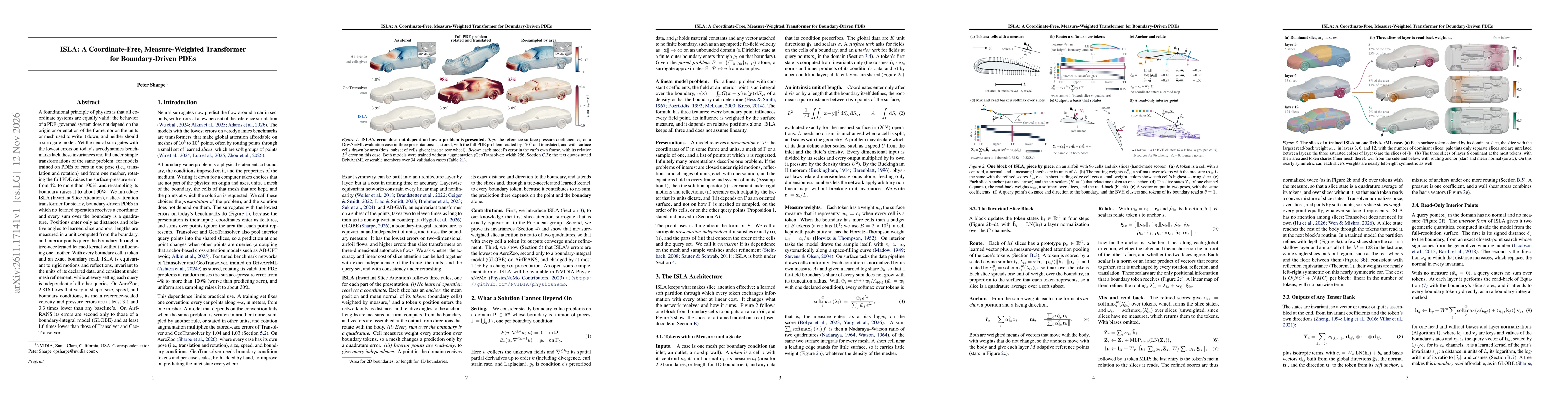
Symmetry is a foundational principle of physics: the behavior of a PDE-governed system does not depend on the coordinate frame, unit system, or mesh used to write it down, and neither should a surrogate model. Yet today's leading neural surrogates lack these invariances and fail under simple transformations of the same problem: for models trained on PDEs of cars in one pose (i.e., translation and rotation), rotating the full PDE raises the surface-pressure error from 4% to more than 100%, and re-sampling its boundary raises it to about 30%. We introduce ISLA (Invariant Slice Attention), a slice-attention transformer for steady, boundary-driven PDEs. Because the boundary determines the interior solution, ISLA encodes the posed boundary once into learned slices and evaluates arbitrary interior points independently through a tree-accelerated learned boundary kernel. Inputs are nondimensionalized in scales computed from the boundary, sums over boundary cells are area-weighted quadratures that converge under mesh refinement, and geometry enters only as distances and relative angles to equivariant slice anchors, making the model equivariant to rigid motions and reflections up to optional token subsampling and tree clustering. On AeroZoo, 2,816 3D flows spanning diverse geometries, poses, physical scales, and boundary conditions, ISLA's mean reference-scaled velocity and pressure errors are 1.9 and 2.2 times lower than the best baseline's. On full AirfRANS, ISLA is second only to an explicit boundary-integral network (GLOBE), with errors 1.6 to 2.6 times lower than the better of Transolver's and GeoTransolver's in every field.
Analysis
AI-generated · verify against the original paper
Generated Jan 1, 0001ResultsWhat the authors found
- On the AeroZoo benchmark (2,816 flows) ISLA’s mean reference‑scaled velocity and pressure errors are at least 3.1× and 3.3× lower than any baseline.
- On AirfRANS, ISLA’s errors are second only to the boundary‑integral model GLOBE and at least 1.6× lower than Transolver and GeoTransolver.
- Changing the presentation (rotation, translation, or re‑sampling) alters ISLA’s error by at most 1.1%.
MethodologyHow the work was done
ISLA (Invariant Slice Attention) is a slice‑attention transformer for steady, boundary‑driven PDEs that receives no coordinates as features; each boundary cell is a token, positions are encoded only as distances and relative angles to learned slice anchors, lengths are measured in a unit computed from the boundary, and interior points query the boundary via a tree‑accelerated learned kernel without influencing each other. All sums over the boundary are performed as quadratures weighted by cell measures, ensuring equivariance to rigid motions and reflections, invariance to units, and consistency under mesh refinement.
SignificanceWhy the work matters
The work demonstrates that enforcing physical invariances—equivariance to the Euclidean group, unit invariance, and mesh‑independence—directly in the architecture yields surrogate models that are far more robust and accurate across diverse problem presentations, addressing a critical limitation of existing neural PDE surrogates.
Technical contributionsWhat the work introduces
Introduces the first slice‑attention transformer that is exactly equivariant to the Euclidean group, proves invariance properties analytically, formulates measure‑weighted attention as a ratio of two quadratures guaranteeing convergence under mesh refinement, and provides an open‑source implementation.
NoveltyHow it differs from prior work
A coordinate‑free, measure‑weighted transformer that eliminates learned coordinate inputs, uses quadrature‑based boundary aggregation, and employs a tree‑accelerated kernel for interior queries, achieving unprecedented invariance to pose, units, and mesh resolution in neural PDE surrogates.
Discussion 0