Isolating the Language Shell: A Content-Controlled Study of Multilingual Reasoning
Abstract
Multilingual reasoning distillation requires choosing the language in which teacher reasoning is presented, yet existing recipes often entangle linguistic form with differences in generation, translation, and filtering. We construct content-controlled supervision by rendering the same verified English trajectories into English, translated target-language, and language-mixed shells, and fine-tune two pretrained students in three target languages, evaluating them on multilingual mathematical reasoning at two difficulty levels. Even with the underlying reasoning content held fixed, we find that shell choice can change downstream accuracy, with effects varying across students, languages, and difficulty levels. Pre-training compatibility does not consistently track these outcomes, and even when our tests find no clear accuracy difference between shells, their output-language behavior can still differ substantially. These results suggest that the supervision shell is a distinct design choice in multilingual reasoning distillation.
Analysis
AI-generated · verify against the original paper
Generated Jan 1, 0001ResultsWhat the authors found
- Pre‑training likelihood yields consistent shell rankings across students but does not reliably predict downstream learnability.
- Shell effects vary with student model, language, and difficulty; less compatible shells sometimes outperform more compatible ones.
- Mixed‑language shells outperform translated shells for Korean and Chinese across multiple training seeds.
- Even when accuracy differences are not significant, the output‑language behavior of models can differ substantially between shells.
LimitationsWhere the findings need caution
- Experiments are limited to two student models and three target languages (Korean, Chinese, German).
- Evaluation is confined to specific benchmarks (PolyMath and MATH‑500) and two difficulty levels.
- Sequence‑length analyses did not provide consistent evidence that length explains observed shell effects.
MethodologyHow the work was done
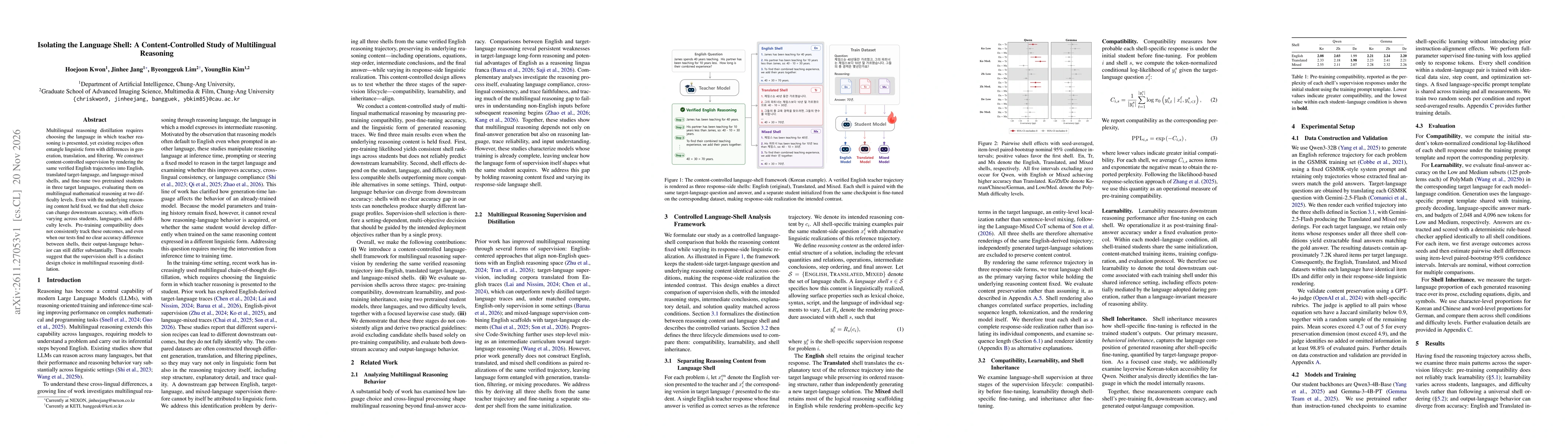
The authors construct a content-controlled supervision framework by rendering the same verified English reasoning trajectories into three language shells (English, translated target-language, and language-mixed). They fine‑tune two pretrained student models separately for each shell across three target languages and evaluate them on multilingual mathematical reasoning tasks at two difficulty levels, measuring pre‑training compatibility, downstream accuracy, and output‑language behavior.
SignificanceWhy the work matters
The study demonstrates that the choice of supervision language shell is an independent design variable that materially influences multilingual reasoning performance and behavior, informing how multilingual reasoning distillation should be configured.
Technical contributionsWhat the work introduces
Introduces a content‑controlled language‑shell framework for multilingual reasoning supervision and provides a systematic evaluation across pre‑training compatibility, downstream learnability, and post‑training inheritance stages.
NoveltyHow it differs from prior work
First work to isolate the effect of the supervision language shell by keeping the underlying reasoning content fixed while varying only the linguistic realization.
Future workQuestions that remain
- Extend the framework to additional languages and more diverse student architectures.
- Investigate other forms of language shells and curriculum strategies such as progressive code‑switching.
- Conduct deeper analyses of why output‑language behavior diverges despite similar accuracy.
Discussion 0