This paper theoretically investigates the Josephson effect and spin-pairing correlations in planar SF1F2S junctions, finding that long-range spin-triplet correlations predominantly influence the second harmonic in asymmetric junctions, while symmetric junctions show no such correlation despite disorder.
Abstract
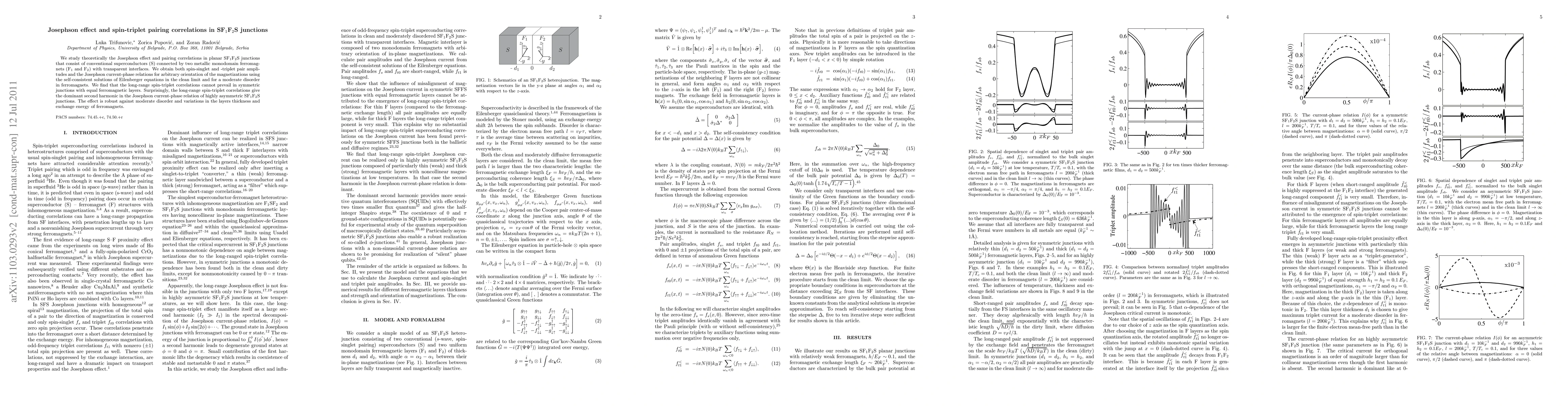
We study theoretically the Josephson effect and pairing correlations in planar SF1F2S junctions that consist of conventional superconductors (S) connected by two metallic monodomain ferromagnets (F1 and F2) with transparent interfaces. We obtain both spin-singlet and -triplet pair amplitudes and the Josephson current-phase relations for arbitrary orientation of the magnetizations using the self-consistent solutions of Eilenberger equations in the clean limit and for a moderate disorder in ferromagnets. We find that the long-range spin-triplet correlations cannot prevail in symmetric junctions with equal ferromagnetic layers. Surprisingly, the long-range spin-triplet correlations give the dominant second harmonic in the Josephson current-phase relation of highly asymmetric SF1F2S junctions. The effect is robust against moderate disorder and variations in the layers thickness and exchange energy of ferromagnets.
AI Key Findings
Get AI-generated insights about this paper's methodology, results, significance, and more — available when analysis has been generated.
Discussion 0