LaN Structural and Topological Transitions Driven by Temperature and Pressure
This study reveals that lanthanum mononitride (LaN) undergoes significant structural, ferroelectric, and topological transitions driven by temperature and pressure. At 0 K, LaN adopts a dynamically stable $P1$ structure with spontaneous polarization, transitioning to the $Fm\bar{3}m$ rock-salt phase with increasing temperature and to a tetragonal $P4/nmm$ structure at 18 GPa. The high-temperature rock-salt phase transforms into a topological insulator at pressures around 14-18 GPa.
Abstract
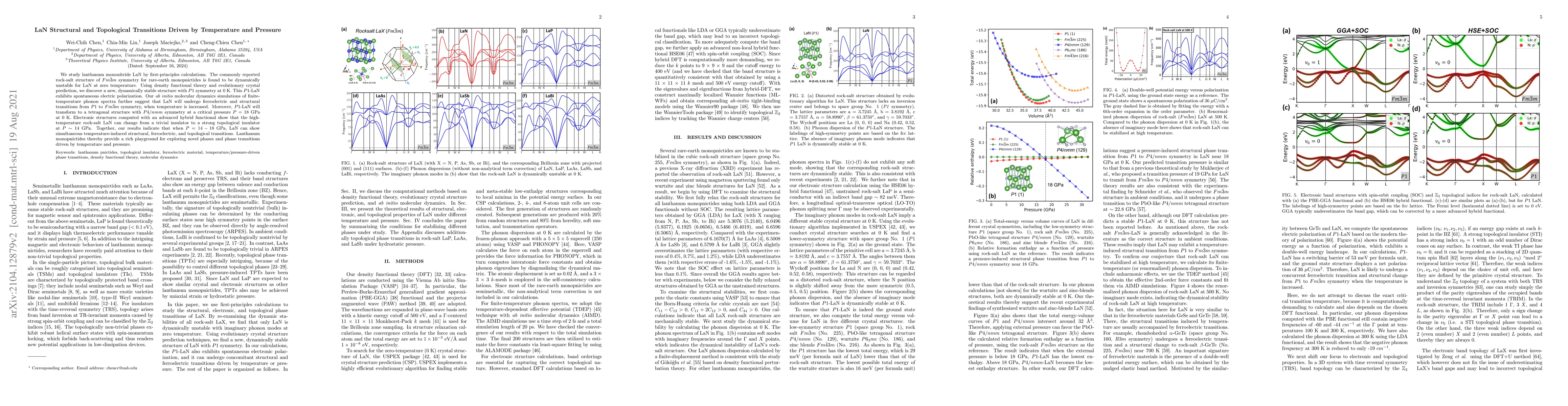
We study lanthanum mononitride LaN by first-principles calculations. The commonly reported rock-salt structure of $Fm\bar{3}m$ symmetry for rare-earth monopnictides is found dynamically unstable for LaN at zero temperature. Using density functional theory and evolutionary crystal prediction, we discover a new, dynamically stable structure with $P1$ symmetry at 0 K. This $P1$-LaN exhibits spontaneous electric polarization. Our ab initio molecular dynamics simulations of finite-temperature phonon spectra further suggest that LaN will undergo ferroelectric and structural transitions from $P1$ to $Fm\bar{3}m$ symmetry, when temperature is increased. Moreover, $P1$-LaN will transform to a tetragonal structure with $P4/nmm$ symmetry at a critical pressure $P=18$ GPa at 0 K. Electronic structures computed with an advanced hybrid functional show that the high-temperature rock-salt LaN can change from a trivial insulator to a strong topological insulator at $P \sim 14$ GPa. Together, our results indicate that when $P=14 - 18$ GPa, LaN can show simultaneous temperature-induced structural, ferroelectric, and topological transitions. Lanthanum monopnictides thereby provide a rich playground for exploring novel phases and phase transitions driven by temperature and pressure.
AI Key Findings
Get AI-generated insights about this paper's methodology, results, significance, and more — available when analysis has been generated.
Discussion 0