Language Model Decomposition: Quantifying the Dependency and Correlation of Language Models
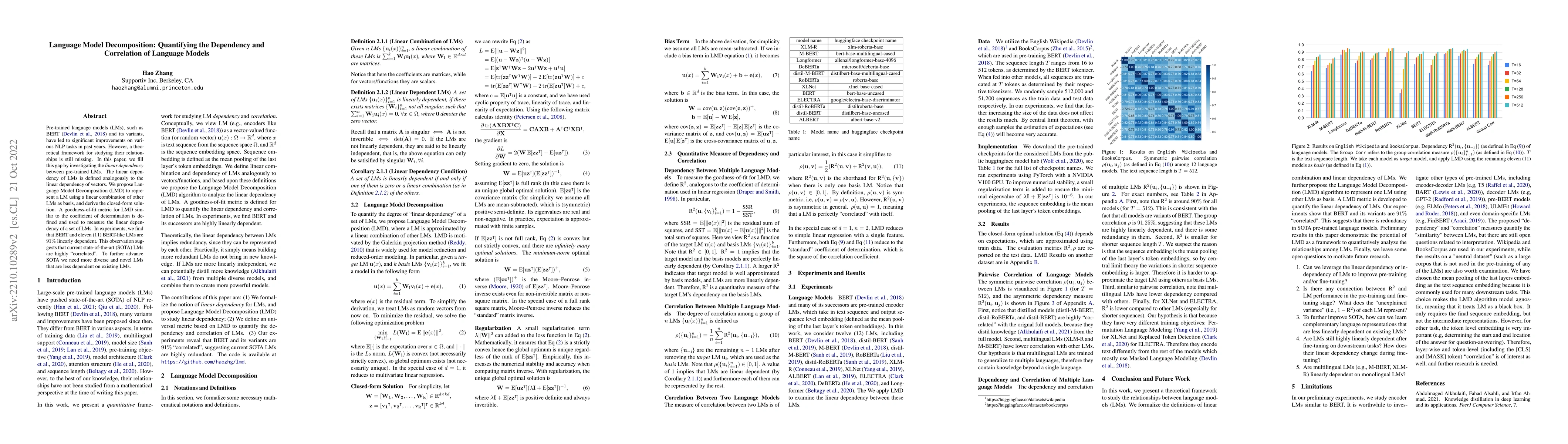
This paper proposes Language Model Decomposition (LMD) to quantify the linear dependency between pre-trained language models like BERT, revealing that 91% of BERT and similar models are linearly dependent. It suggests that to advance state-of-the-art NLP, we need more diverse language models.
Abstract
Pre-trained language models (LMs), such as BERT (Devlin et al., 2018) and its variants, have led to significant improvements on various NLP tasks in past years. However, a theoretical framework for studying their relationships is still missing. In this paper, we fill this gap by investigating the linear dependency between pre-trained LMs. The linear dependency of LMs is defined analogously to the linear dependency of vectors. We propose Language Model Decomposition (LMD) to represent a LM using a linear combination of other LMs as basis, and derive the closed-form solution. A goodness-of-fit metric for LMD similar to the coefficient of determination is defined and used to measure the linear dependency of a set of LMs. In experiments, we find that BERT and eleven (11) BERT-like LMs are 91% linearly dependent. This observation suggests that current state-of-the-art (SOTA) LMs are highly "correlated". To further advance SOTA we need more diverse and novel LMs that are less dependent on existing LMs.
AI Key Findings
Get AI-generated insights about this paper's methodology, results, significance, and more — available when analysis has been generated.
Discussion 0