Large Motion Video Super-Resolution with Dual Subnet and Multi-Stage Communicated Upsampling
This paper proposes a novel deep neural network with Dual Subnet and Multi-Stage Communicated Upsampling (DSMC) for enhancing video super-resolution, especially for videos with large motion. The method includes a U-shaped residual dense network with 3D convolution for motion estimation and a Multi-Stage Communicated Upsampling module to leverage intermediate upsampling results for better guidance.
Abstract
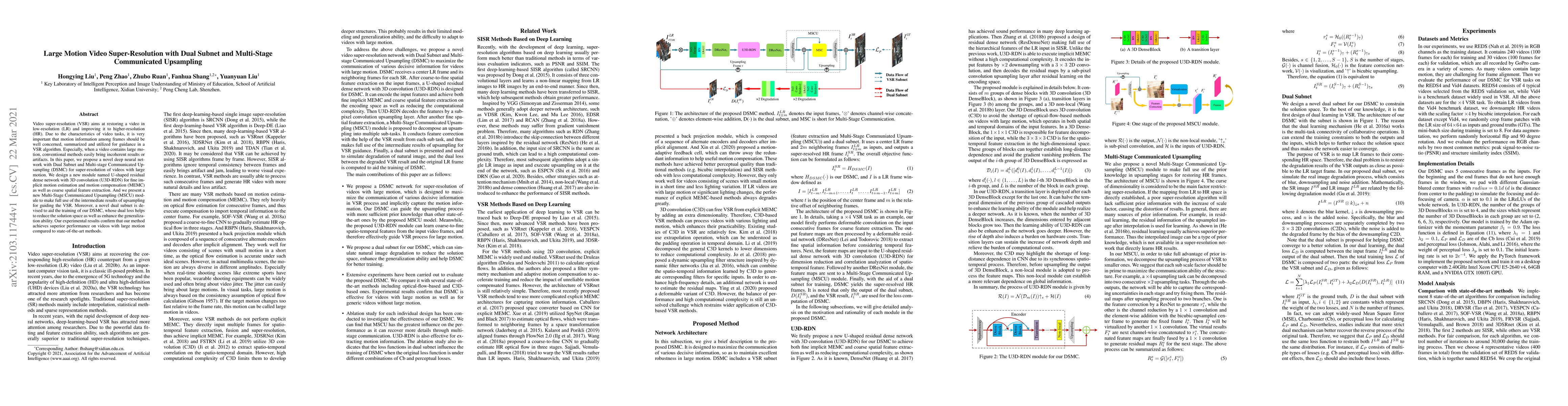
Video super-resolution (VSR) aims at restoring a video in low-resolution (LR) and improving it to higher-resolution (HR). Due to the characteristics of video tasks, it is very important that motion information among frames should be well concerned, summarized and utilized for guidance in a VSR algorithm. Especially, when a video contains large motion, conventional methods easily bring incoherent results or artifacts. In this paper, we propose a novel deep neural network with Dual Subnet and Multi-stage Communicated Upsampling (DSMC) for super-resolution of videos with large motion. We design a new module named U-shaped residual dense network with 3D convolution (U3D-RDN) for fine implicit motion estimation and motion compensation (MEMC) as well as coarse spatial feature extraction. And we present a new Multi-Stage Communicated Upsampling (MSCU) module to make full use of the intermediate results of upsampling for guiding the VSR. Moreover, a novel dual subnet is devised to aid the training of our DSMC, whose dual loss helps to reduce the solution space as well as enhance the generalization ability. Our experimental results confirm that our method achieves superior performance on videos with large motion compared to state-of-the-art methods.
AI Key Findings
Get AI-generated insights about this paper's methodology, results, significance, and more — available when analysis has been generated.
Discussion 0