Large Spin-Wave Fluctuations Suppress Activity in Malthusian Flocks
Abstract
Novel phases, beyond long-range order in two dimensions, have continued to be discovered within flocking models, establishing flocking as one of the pivotal paradigms in active matter. However, much of the discussion around ``Malthusian'' (constant density) flocks, an analytically more tractable alternative to the Vicsek model, has centred around the scaling exponents governing the intermediate regime prior to the proliferation of asters, leaving open the question of what other phases the model might display. Here, we study the two-dimensional dynamics of Malthusian flocks and identify a previously unnoticed phase, where the dynamics is that of the equilibrium XY Model. By identifying the symmetries of the model, we derive the effective equations of motion for the Goldstone modes and analyse the spin-wave fluctuations. We identify a novel critical point separating two distinct phases and, using a perturbative RG procedure, determine the RG flows in its vicinity. This allows us to calculate the universal scaling behaviour at the critical point, along with its logarithmic corrections. The novel phase transition here is due to the interaction of activity and spin-waves, unlike the equilibrium counterpart, which undergoes a phase transition in effective degrees of freedom, namely vortices. Nevertheless, the RG flows are similar to those of the Berezinskii-Kosterlitz-Thouless transition, and we show that for sufficiently strong noise, the activity becomes irrelevant and the system crosses over to the equilibrium XY universality class.
Analysis
AI-generated · verify against the original paper
Generated Aug 9, 2026ResultsWhat the authors found
- Identification of a novel phase in d=2 Malthusian flocks where large-scale dynamics mirror the equilibrium XY model due to spin-wave fluctuations.
- Derivation of the Goldstone-mode EoM constrained by SO(2) rotational and Z2 parity symmetries, including gradient terms and activity-induced couplings.
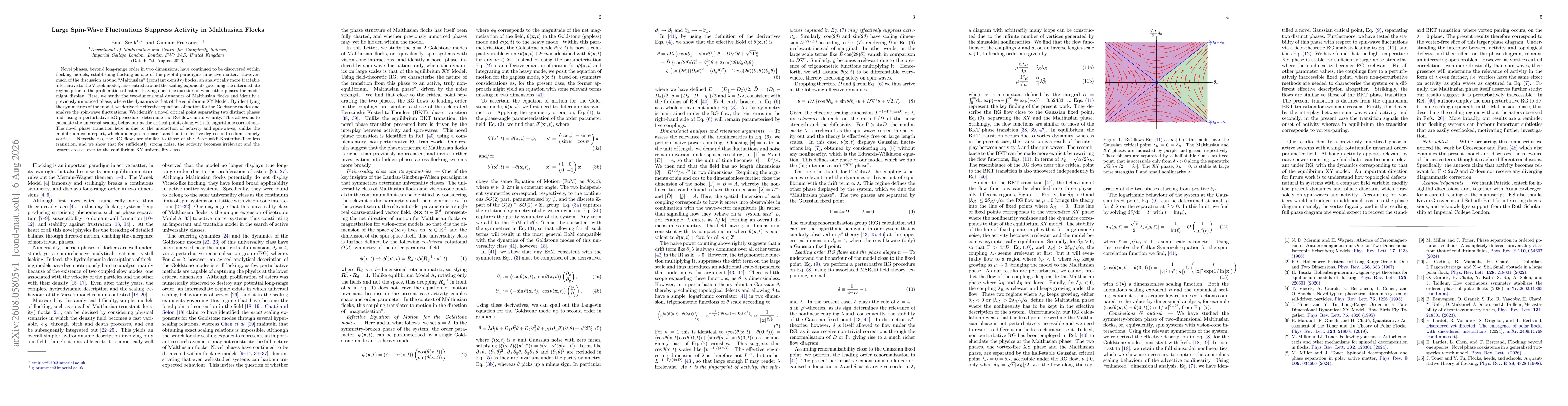
- RG analysis reveals leading-order flows near a separatrix reminiscent of BKT transitions, indicating a novel non-equilibrium transition driven by activity-spin-wave interaction.
- Demonstration that with sufficiently strong noise, activity becomes irrelevant and the system crosses over to the equilibrium XY universality class.
LimitationsWhere the findings need caution
- Relies on perturbative RG near Gaussian fixed point; non-perturbative effects or strong-coupling regimes may modify the conclusions.
- Analysis is tailored to d=2 with specific symmetry constraints; generalization to other dimensions or interaction types is not provided.
- Assumes certain noise statistics and gradient expansions; deviations could affect the universality class or critical behavior.
MethodologyHow the work was done
The authors implement a field-theoretic renormalization group (RG) analysis for two-dimensional Malthusian flocks by focusing on the Goldstone mode of the order parameter and deriving its effective equation of motion (EoM) constrained by the system's continuous SO(2) and discrete Z2 symmetries. They parameterize the order parameter with a magnitude and a phase (Goldstone mode) plus a heavy mode, derive the Langevin equation for the Goldstone mode up to second-order gradients, and perform perturbative RG to obtain flow equations for the couplings. They analyze logarithmic corrections near the Gaussian fixed point, solve the RG flow to leading order, and compare the resulting scaling to BKT-like behavior, identifying a novel phase transition driven by activity-spin-wave interplay and crossover to the equilibrium XY universality class at strong noise.
SignificanceWhy the work matters
The work uncovers a previously unrecognized phase structure in two-dimensional Malthusian flocks, linking non-equilibrium active matter to equilibrium XY physics via a spin-wave–driven mechanism and offering a perturbative RG framework to quantify universal scaling and logarithmic corrections at the critical point.
Technical contributionsWhat the work introduces
A field-theoretic RG treatment of Goldstone-mode dynamics in 2D Malthusian flocks, yielding explicit EoMs constrained by symmetry, deriving RG flow equations for activity and spin-wave couplings, and obtaining the scaling form with logarithmic corrections near a novel critical point that connects to BKT-like behavior and the equilibrium XY universality class under strong noise.
NoveltyHow it differs from prior work
First analytical identification of an XY-like phase arising from spin-wave fluctuations in active Malthusian flocks, plus a perturbative RG framework showing a non-equilibrium phase transition driven by activity-spin-wave interplay with BKT-like flow structure and a noise-induced crossover to equilibrium universality.
Future workQuestions that remain
- Extend non-perturbative RG treatments to explore the full phase diagram beyond near-Gaussian scaling.
- Investigate finite-size and boundary effects on the spin-wave–driven transition in simulations and experiments.
- Generalize the framework to other active matter models with vision-cone interactions and higher spin representations.
- Explore experimental realizations in synthetic active nematics or microbial systems to observe the predicted crossover to XY universality.
Discussion 0