LaT: LLM-as-Trainer for Multi-Task Vehicle Routing Solvers
LaT uses a pretrained language model as an external trainer to guide multi-task VRP solvers by periodically creating stage-wise training signals from cross-task validation. These signals, combined with each task’s constraints and injected into the encoder, improve solution quality across 16 VRP variants, including unseen ones, without extra heavy optimization.
Abstract
Multi-task neural solvers aim to handle multiple Vehicle Routing Problem (VRP) variants within a unified model, avoiding separate training for each constraint combination. However, VRP variants differ in optimization difficulty, while existing methods lack stage-wise feedback on their training status, making the model biased to some specific variants. Although meta-learning can support adaptive training, it typically requires bi-level optimization and additional gradient updates, increasing computational cost. To address this limitation, we propose LLM-as-Trainer (LaT), a plug-and-play training paradigm that uses a pretrained large language model as an external trainer. LaT periodically analyzes cross-task validation metrics to generate a stage-wise guidance vector. This vector is combined with the current task's constraint vector and injected into each encoder layer, providing the neural solver with additional training information during subsequent policy optimization. Experiments on 16 VRP variants show that LaT improves the solution quality of several state-of-the-art multi-task neural solvers on both trained and unseen variants, supporting the effectiveness and generality of the proposed training paradigm.
Analysis
AI-generated · verify against the original paper
Generated Jul 22, 2026ResultsWhat the authors found
- LaT improves overall solution quality across 16 VRP variants for several state-of-the-art multi-task neural solvers on both trained and unseen variants.
- Compared to MLP guidance baselines, LaT achieves smaller average gaps (e.g., 4.21% average gap vs 4.32% with MLP) and shows notable gains on multi-constraint variants such as OVRPBTW, VRPBLTW, and OVRPBLTW.
- Ablation indicates injecting the guidance after every encoder layer (LaTEncAll) yields the best average score and gap, supporting the effectiveness of stage-wise cross-task feedback.
LimitationsWhere the findings need caution
- The approach relies on the quality and relevance of cross-task validation signals from the LLM, which may vary with tasks or data distributions.
- Experimental validation is focused on VRP variants and may not directly translate to unrelated combinatorial problems without adaptation.
- There is an added dependency on the scheduling of when to query the LLM and how to integrate its guidance, which may require task-specific tuning.
MethodologyHow the work was done
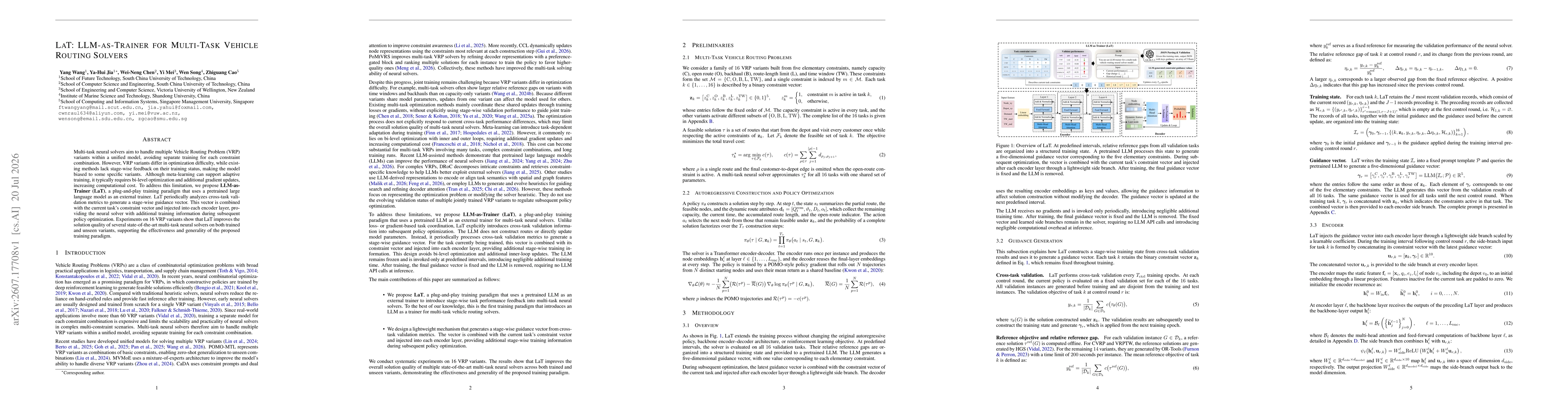
LaT uses a frozen pretrained LLM as an external trainer that periodically analyzes cross-task validation metrics to generate a stage-wise guidance vector. This vector is combined with the current task's constraint vector and injected into each encoder layer of the neural VRP solver during subsequent policy optimization, avoiding bi-level optimization and inner-loop updates. The LLM is invoked at predefined intervals; after generating a fixed guidance vector, the LLM is removed from the training loop and no API calls occur during inference.
SignificanceWhy the work matters
The proposed LaT paradigm introduces a low-cost, plug-and-play external trainer that leverages cross-task validation to steer multi-task VRP solvers without expensive meta-learning or inner-loop optimization, potentially enhancing generalization to unseen variants while maintaining training efficiency.
Technical contributionsWhat the work introduces
We introduce LaT, a plug-and-play training paradigm that uses a frozen pretrained LLM as an external trainer to generate stage-wise guidance vectors from cross-task validation; these vectors are injected into encoder layers during policy optimization to improve multi-task VRP solver performance without bi-level optimization.
NoveltyHow it differs from prior work
First training paradigm to employ an external frozen LLM as a trainer for multi-task vehicle routing solvers by leveraging cross-task validation signals for stage-wise guidance, enabling improved generalization to unseen VRP variants while avoiding inner-loop gradient updates.
Future workQuestions that remain
- Explore adaptive scheduling strategies for LLM invocation to better align guidance frequency with training dynamics.
- Extend LaT to other domains with multi-task objectives to assess generality and impact on different solver architectures.
- Investigate more efficient fusion mechanisms for guidance vectors to further reduce any potential overhead during training.
Discussion 0