LayeredFlow: A Real-World Benchmark for Non-Lambertian Multi-Layer Optical Flow
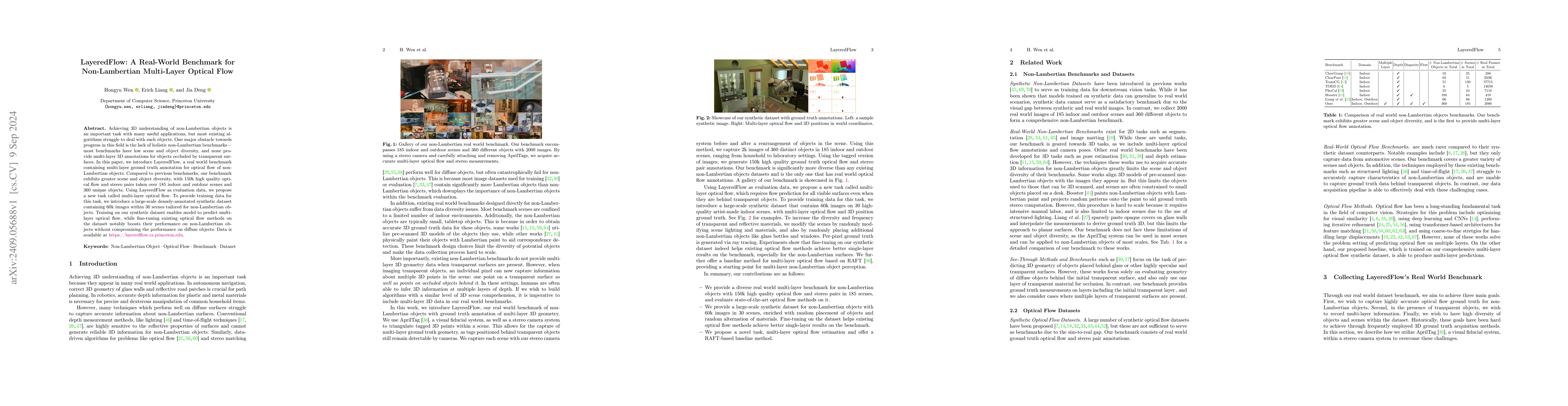
LayeredFlow introduces a comprehensive benchmark for multi-layer optical flow of non-Lambertian objects, featuring 150k high-quality optical flow and stereo pairs across diverse indoor and outdoor scenes. To support this benchmark, a synthetic dataset with 60k images is also provided, aiding in the training of models for multi-layer optical flow tasks.
Abstract
Achieving 3D understanding of non-Lambertian objects is an important task with many useful applications, but most existing algorithms struggle to deal with such objects. One major obstacle towards progress in this field is the lack of holistic non-Lambertian benchmarks -- most benchmarks have low scene and object diversity, and none provide multi-layer 3D annotations for objects occluded by transparent surfaces. In this paper, we introduce LayeredFlow, a real world benchmark containing multi-layer ground truth annotation for optical flow of non-Lambertian objects. Compared to previous benchmarks, our benchmark exhibits greater scene and object diversity, with 150k high quality optical flow and stereo pairs taken over 185 indoor and outdoor scenes and 360 unique objects. Using LayeredFlow as evaluation data, we propose a new task called multi-layer optical flow. To provide training data for this task, we introduce a large-scale densely-annotated synthetic dataset containing 60k images within 30 scenes tailored for non-Lambertian objects. Training on our synthetic dataset enables model to predict multi-layer optical flow, while fine-tuning existing optical flow methods on the dataset notably boosts their performance on non-Lambertian objects without compromising the performance on diffuse objects. Data is available at https://layeredflow.cs.princeton.edu.
AI Key Findings
Get AI-generated insights about this paper's methodology, results, significance, and more — available when analysis has been generated.
Discussion 0