LDU-Bench: Multimodal LLM Evaluation for Lithography Defect Understanding under Layout-Varying Circuit Backgrounds
Abstract
Multimodal large language models have demonstrated strong defect recognition capability in industrial anomaly detection. However, in lithography review, merely determining whether an image contains a defect is insufficient for engineering inspection; models must also understand defect morphology, spatial location, and the potential causes supported by visible evidence. To this end, this paper proposes LDU-Bench, a multi-task multimodal benchmark for lithography defect understanding. Constructed from real lithography and integrated-circuit review images, LDU-Bench decomposes the review workflow into four independent tasks: defect triage, morphology recognition, coarse localization, and image-conditioned cause analysis. It systematically evaluates models using task-level metrics, diagnostic readouts, and the Lithography Closure Score (LCS). Experimental results show that although existing MLLMs can perform defect triage relatively reliably, this ability does not stably transfer to downstream review stages. Morphology alignment, effective localization, and evidence-to-cause mapping remain the major bottlenecks. Further diagnostics indicate that this capability break is not a fluctuation of a single metric, but reflects insufficient structured understanding across semantic levels. Overall, LDU-Bench provides a quantifiable and diagnostic unified platform for evaluating the usability, failure points, and capability boundaries of industrial MLLMs in lithography review chains.
Analysis
AI-generated · verify against the original paper
Generated Aug 6, 2026ResultsWhat the authors found
- Defect triage achieves relatively reliable performance, but this does not consistently translate to downstream tasks such as morphology recognition, localization, and cause analysis.
- Major bottlenecks are morphology alignment, effective localization, and evidence-to-cause mapping, indicating insufficient structured understanding across semantic levels.
- Diagnostic analyses show the drop in capability is not due to a single metric fluctuation but reflects broader gaps in cross-level semantic reasoning.
LimitationsWhere the findings need caution
- Evaluations rely on deterministic scorers and predefined rubrics, which may limit capturing more nuanced model behavior.
- The benchmark is constructed from IC-SEM lithography images; generalizability to other lithography datasets or manufacturing contexts requires validation.
MethodologyHow the work was done
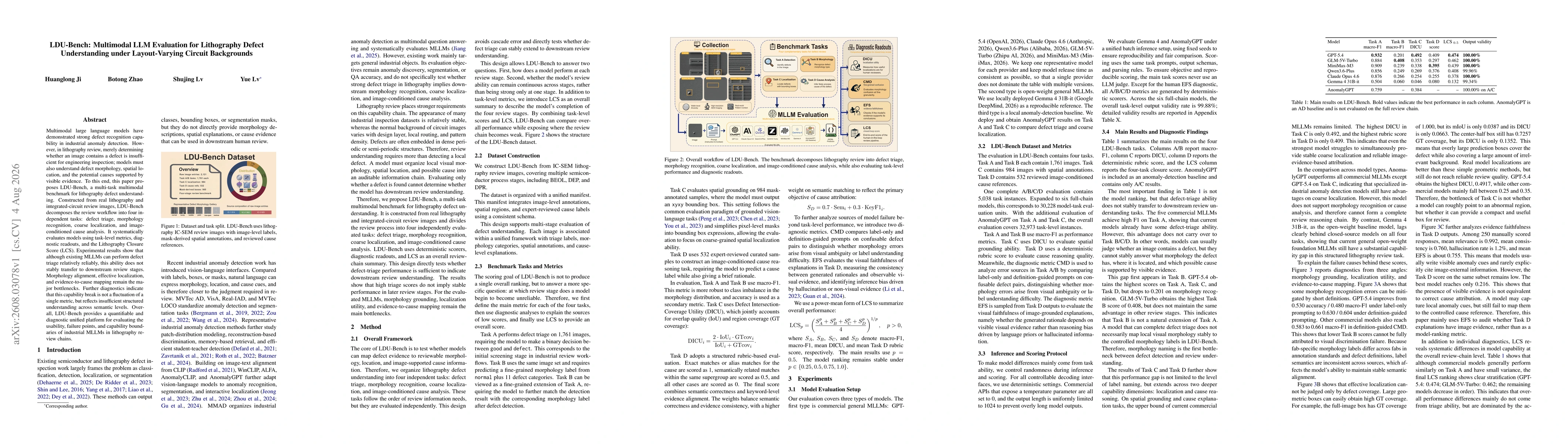
LDU-Bench decomposes lithography defect understanding into four independent tasks (defect triage, morphology recognition, coarse localization, image-conditioned cause analysis) and evaluates them separately to avoid cascading errors, supplemented by the Lithography Closure Score (LCS) for an overall chain summary.
SignificanceWhy the work matters
Provides a quantifiable, diagnostic, and unified platform to evaluate industrial multimodal LLMs in lithography review chains, highlighting where current models fail to maintain reviewability across stages and guiding future improvements in multi-task, evidence-based understanding.
Technical contributionsWhat the work introduces
Introduction of LDU-Bench, a multi-task multimodal benchmark with four independent evaluation tasks and the Lithography Closure Score to diagnose where review chains break in industrial MLLMs.
NoveltyHow it differs from prior work
First work to systematically probe defect triage, morphology grounding, localization, and cause analysis in a unified lithography review framework, emphasizing the continuity of understanding across semantic levels rather than isolated detection performance.
Future workQuestions that remain
- Enhance cross-stage knowledge transfer to improve morphology grounding and localization utility beyond defect triage.
- Develop more robust evidence-to-cause mapping mechanisms and richer causal explanations aligned with industrial review needs.
Discussion 0