Leakage-induced decoherence during single electron spin manipulation in a double quantum dot
This study theoretically investigates coherent single electron spin oscillations in a double quantum dot system, identifying leakage current through the Coulomb blockade barrier as the primary decoherence mechanism during spin manipulation, while nuclear field fluctuations contribute negligibly.
Abstract
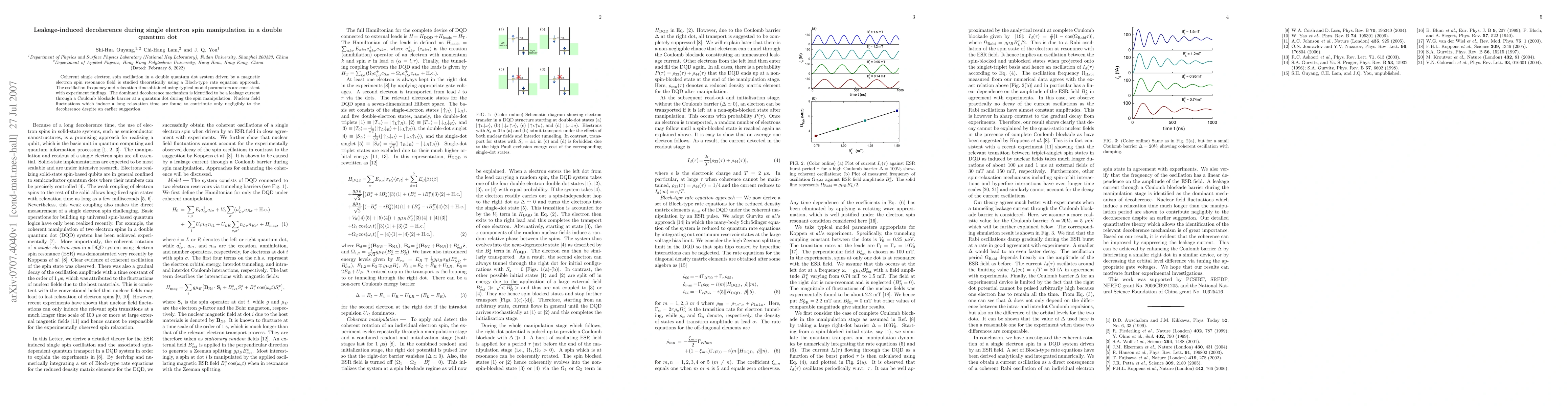
Coherent single electron spin oscillation in a double quantum dot system driven by a magnetic electron spin resonance field is studied theoretically using a Bloch-type rate equation approach. The oscillation frequency and relaxation time obtained using typical model parameters are consistent with experiment findings. The dominant decoherence mechanism is identified to be a leakage current through a Coulomb blockade barrier at a quantum dot during the spin manipulation. Nuclear field fluctuations which induce a long relaxation time are found to contribute only negligibly to the decoherence despite an earlier suggestion.
Analysis
AI-generated · verify against the original paper
Generated Sep 4, 2025ResultsWhat the authors found
- Theoretical model predicts coherent Rabi oscillations between the spin-blocked and unblocked states.
- Numerical simulations show good agreement with experimental results for the Rabi frequency and decay rate.
- Leakage current through a Coulomb blockade barrier is identified as the dominant mechanism of decoherence.
- Enhancing the Coulomb barrier or tuning the orbital level difference can improve coherence.
- Theoretical model provides a novel understanding of the interplay between spin relaxation mechanisms.
LimitationsWhere the findings need caution
- Assumes idealized conditions for the Coulomb blockade barrier
- Simplifies the treatment of non-equilibrium dynamics
MethodologyHow the work was done
A set of Bloch equations were derived analytically and integrated numerically to study the coherent rotation of a single electron spin in a double quantum dot system driven by an ESR field.
SignificanceWhy the work matters
This work demonstrates the importance of considering leakage current in the study of quantum systems and provides a theoretical framework for improving coherence.
Technical contributionsWhat the work introduces
The development of a theoretical framework for studying coherent Rabi oscillations in a double quantum dot system driven by an ESR field.
NoveltyHow it differs from prior work
This work introduces a novel understanding of the interplay between spin relaxation mechanisms and provides a new perspective on the study of quantum systems.
Future workQuestions that remain
- Investigating the effects of disorder on the Rabi frequency and decay rate
- Developing a more realistic model of the Coulomb blockade barrier
- Exploring alternative mechanisms for decoherence
Discussion 0