Learned Network Dynamics for Model Predictive Traffic Signal Control under Incidents
Abstract
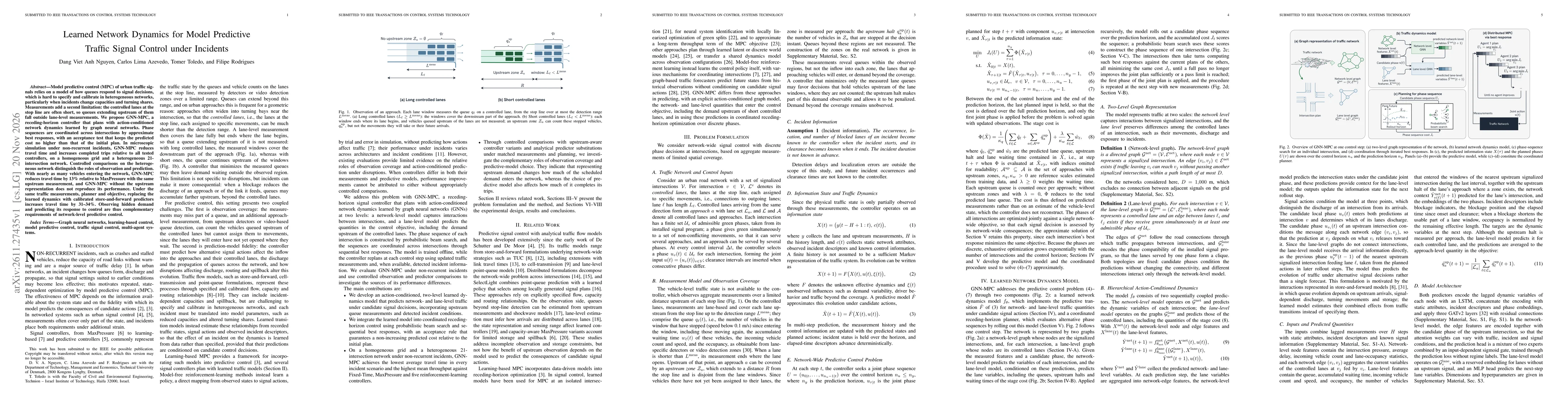
Model predictive control (MPC) of urban traffic signals relies on a model of how queues respond to signal decisions, which is hard to specify and calibrate in heterogeneous networks, particularly when incidents change capacities and turning shares. Measurements add a second limitation: the controlled lanes at the stop line are often short, so queues extending upstream of them fall outside lane-level measurements. We propose GNN-MPC, a receding-horizon controller that plans with action-conditioned network dynamics learned by graph neural networks. Phase sequences are coordinated across intersections by approximate best responses, with an acceptance test that keeps the predicted cost no higher than that of the initial plan. In microscopic simulation under non-recurrent incidents, GNN-MPC reduces travel time and increases completed trips relative to all tested controllers, on a homogeneous grid and a heterogeneous 21-intersection network. Controlled comparisons on the heterogeneous network distinguish the roles of observation and prediction. With nearly as many vehicles entering the network, GNN-MPC reduces travel time by 13% relative to MaxPressure with the same upstream measurement, and GNN-MPC without the upstream representation does not reproduce its performance. Under the same traffic measurements, planner and objective, replacing the learned dynamics with calibrated store-and-forward predictors increases travel time by 31-34%. Observing hidden demand and predicting its response to control are thus complementary requirements of network-level predictive control.
Analysis
AI-generated · verify against the original paper
Generated Jan 1, 0001ResultsWhat the authors found
- In microscopic simulations under non‑recurrent incidents, GNN‑MPC achieved the lowest average travel time and highest mean throughput among all tested controllers on both a homogeneous grid and a heterogeneous 21‑intersection network.
- Compared to MaxPressure with the same upstream measurement, GNN‑MPC reduced travel time by 13% while maintaining similar vehicle entry rates.
- Replacing the learned dynamics with calibrated store‑and‑forward predictors increased travel time by 31–34%, highlighting the benefit of the learned model.
- A variant of GNN‑MPC without upstream representation failed to reproduce the performance gains, indicating the importance of upstream demand observation.
LimitationsWhere the findings need caution
- The dynamics model is trained offline and may require retraining or adaptation for significantly different network topologies or incident patterns.
- Performance depends on the availability of upstream queue measurements; without such data, the controller’s advantage diminishes.
MethodologyHow the work was done
GNN-MPC is a receding-horizon model predictive controller that uses action‑conditioned network dynamics learned by graph neural networks at both network and lane levels. The learned model predicts traffic responses to candidate signal actions, incorporating upstream queue measurements and incident information. Phase sequences are generated via probabilistic beam search and coordinated across intersections using sequential best‑response updates with an acceptance test that ensures the predicted cost does not increase relative to the initial plan.
SignificanceWhy the work matters
The work demonstrates that combining upstream demand observation with action‑conditioned learned traffic dynamics enables superior predictive traffic signal control under incident‑induced capacity changes, outperforming both classical analytical models and reinforcement‑learning baselines.
Technical contributionsWhat the work introduces
Introduction of a two‑level, action‑conditioned graph neural network model for traffic dynamics integrated into a coordinated receding‑horizon MPC framework with a cost‑non‑increasing acceptance rule.
NoveltyHow it differs from prior work
First integration of learned, action‑conditioned network dynamics via GNNs into a coordinated MPC for traffic signal control that explicitly leverages upstream demand observations under incident conditions.
Discussion 0