Learning Behaviorally Relevant Dynamics in Multimodal Neural Recordings
Abstract
Multimodal neural data can enable a more complete understanding of brain dynamics underlying behavior. Modalities such as spiking activity, local field potentials (LFPs), and behavior capture diverse spatiotemporal aspects of brain processes, yet prior neural-behavioral models that separate sources of variability rely on a single neural modality. By leveraging these complementary strengths, multimodal neural fusion can provide a unified, rich representation of brain-behavior processes and address the limitations of single-modality analyses. Here we develop BREM-NET, a nonlinear multimodal dynamical model that integrates behavior with multiple neural modalities having distinct statistical characteristics and temporal resolutions. BREM-NET performs multimodal neural fusion during inference while separating behaviorally relevant and residual neural dynamics via a structured learning framework. In a public multimodal non-human primate dataset with simultaneous spiking and local field potential recordings during a 2D reaching task, BREM-NET separates these two types of dynamics and learns them more accurately, as reflected in better behavior decoding, better neural prediction, and stronger latent alignment with behavior, and it retains these capabilities when neural modalities are asynchronous or suffer dropouts, which are major challenges in real-world recordings. This framework provides a new tool for studying behaviorally relevant neural computations across spatiotemporal scales of brain activity.
Analysis
AI-generated · verify against the original paper
Generated Jan 1, 0001ResultsWhat the authors found
- BREM-NET achieves higher behavior decoding accuracy and stronger alignment of latent trajectories with true velocity compared to single‑modal baselines.
- The model improves neural prediction for both LFP and spike modalities, with residual latents capturing variability missed by behaviorally relevant latents.
- Performance remains robust when neural modalities are sampled asynchronously or suffer dropouts.
- Ablation studies show that multimodal fusion, behavior supervision, and the staged learning each contribute to superior decoding and prediction.
MethodologyHow the work was done
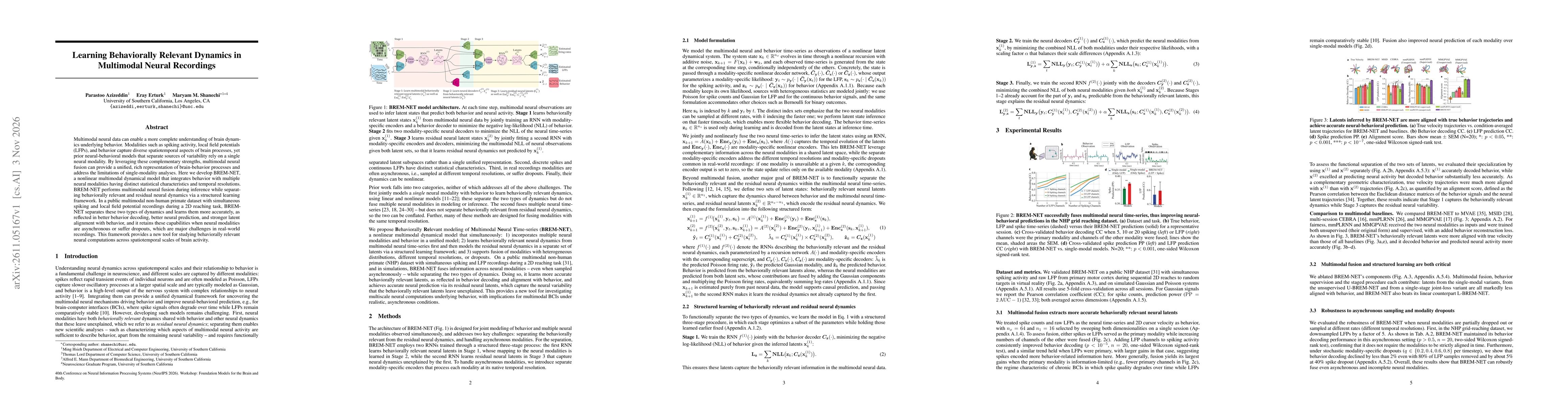
BREM-NET is a nonlinear multimodal dynamical model that uses a structured three-stage learning framework with two recurrent neural networks (RNNs). Stage 1 learns behaviorally relevant neural latents from multimodal data via modality-specific encoders and a behavior decoder; Stage 2 fits modality-specific neural decoders to predict neural activity from these latents; Stage 3 learns residual neural latents with a second RNN to capture dynamics not explained by the behaviorally relevant latents. Separate encoders process each modality at its native temporal resolution, enabling fusion of asynchronous or dropout‑prone recordings.
SignificanceWhy the work matters
The framework provides a new tool for investigating behaviorally relevant neural computations across spatiotemporal scales, enabling more accurate brain‑computer interface models and deeper insight into multimodal brain‑behavior dynamics.
Technical contributionsWhat the work introduces
A unified multimodal neural‑behavioral model that simultaneously fuses heterogeneous neural recordings and separates behaviorally relevant from residual dynamics via a structured three‑stage RNN learning process.
NoveltyHow it differs from prior work
First approach to integrate multiple neural modalities with behavior while explicitly disentangling behaviorally relevant and residual dynamics and handling asynchronous sampling and data dropouts.
Discussion 0