Learning from Natural Images Untangles Number Sense
Abstract
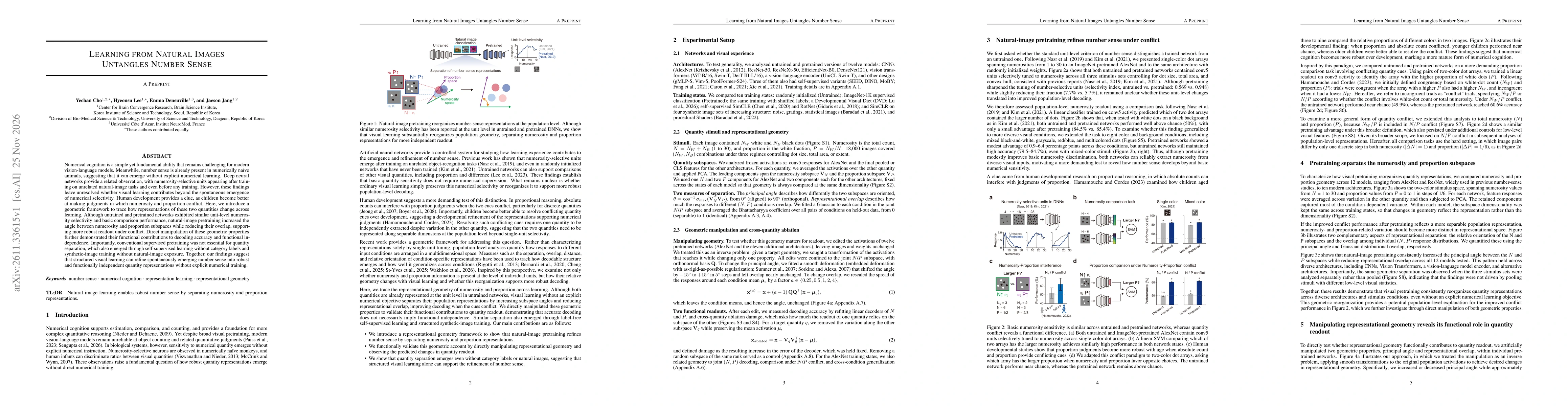
Numerical cognition is a simple yet fundamental ability that remains challenging for modern vision-language models. Meanwhile, number sense is already present in numerically naïve animals, suggesting that it can emerge without explicit numerical learning. Deep neural networks provide a related observation, with numerosity-selective units appearing after training on unrelated natural-image tasks and even before any training. However, these findings leave unresolved whether visual learning contributes beyond the spontaneous emergence of numerical selectivity. Human development provides a clue, as children become better at making judgments in which numerosity and proportion conflict. Here, we introduce a geometric framework to trace how representations of these two quantities change across learning. Although untrained and pretrained networks exhibited similar unit-level numerosity selectivity and basic comparison performance, natural-image pretraining increased the angle between numerosity and proportion subspaces while reducing their overlap, supporting more robust readout under conflict. Direct manipulation of these geometric properties further demonstrated their functional contributions to decoding accuracy and functional independence. Importantly, conventional supervised pretraining was not essential for quantity separation, which also emerged through self-supervised learning without category labels and synthetic-image training without natural-image exposure. Together, our findings suggest that structured visual learning can refine spontaneously emerging number sense into robust and functionally independent quantity representations without explicit numerical training.
Analysis
AI-generated · verify against the original paper
Generated Jan 1, 0001ResultsWhat the authors found
- Both untrained and pretrained networks exhibited similar unit‑level numerosity selectivity and basic comparison performance.
- Natural‑image pretraining increased the angle between numerosity and proportion subspaces while reducing their overlap, leading to more robust decoding under cue conflict.
- Direct manipulation of these geometric properties confirmed their functional contribution to decoding accuracy and functional independence.
- Quantity separation also emerged through self‑supervised learning without category labels and through synthetic‑image training without natural‑image exposure.
MethodologyHow the work was done
We introduced a representational‑geometry framework to trace how numerosity and proportion representations change across learning, measuring subspace angles, overlap, and decoding accuracy in untrained, natural‑image‑pretrained, self‑supervised, and synthetic‑image‑trained deep networks.
SignificanceWhy the work matters
The study shows that structured visual learning can refine spontaneously emerging number sense into robust, functionally independent quantity representations without any explicit numerical training, highlighting a pathway for improving quantitative reasoning in vision‑language models.
Technical contributionsWhat the work introduces
We provided a novel geometric analysis method to quantify and manipulate the population‑level separation of numerosity and proportion representations, linking these metrics to functional decoding performance.
NoveltyHow it differs from prior work
This work is the first to demonstrate that both supervised natural‑image pretraining and self‑supervised or synthetic visual training can reorganize spontaneously emergent number‑sense representations into distinct, independent subspaces without explicit numerical supervision.
Discussion 0