Learning Interaction Dynamics via Motion-Region Guidance for Robotic Video World Models
Abstract
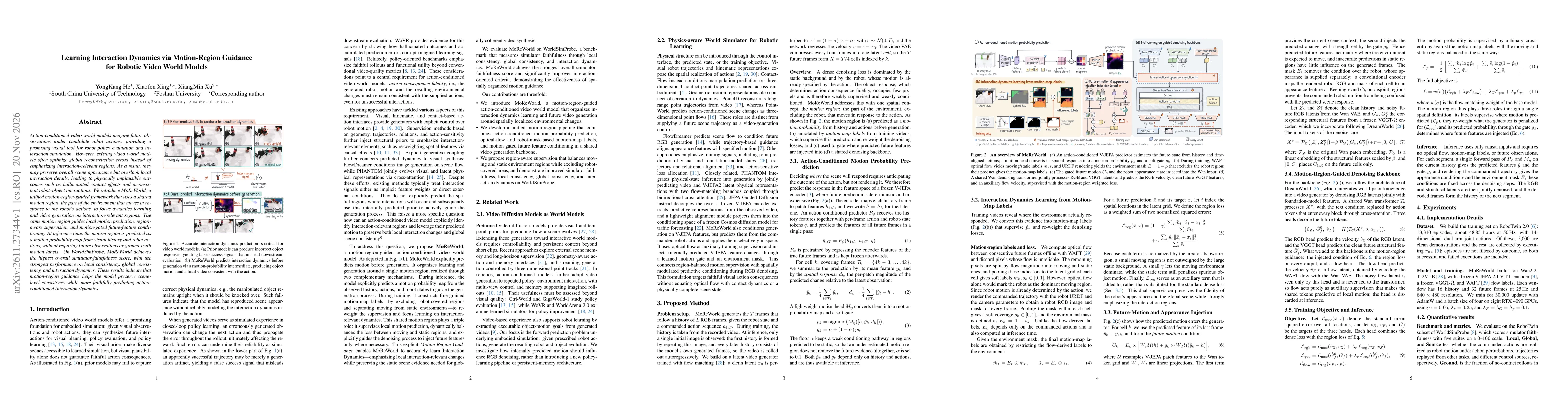
Action-conditioned video world models imagine future observations under candidate robot actions, providing a promising visual tool for robot policy evaluation and interaction simulation. However, existing video world models often optimize global reconstruction errors instead of emphasizing interaction-relevant regions. As a result, they may preserve overall scene appearance but overlook local interaction details, leading to physically implausible outcomes such as hallucinated contact effects and inconsistent robot-object interactions. We introduce MoReWorld, a unified motion-region-guided framework that uses a shared motion region, the part of the environment that moves in response to the robot's actions, to focus dynamics learning and video generation on interaction-relevant regions. The same motion region guides local motion prediction, region-aware supervision, and motion-gated future-feature conditioning. At inference time, the motion region is predicted as a motion probability map from visual history and robot actions, without requiring future observations or ground-truth motion labels. On WorldSimProbe, MoReWorld achieves the highest overall simulator-faithfulness score, with the strongest performance on local consistency, global consistency, and interaction dynamics. These results indicate that motion-region guidance helps the model preserve scene-level consistency while more faithfully predicting action-conditioned interaction dynamics.
Analysis
AI-generated · verify against the original paper
Generated Jan 1, 0001ResultsWhat the authors found
- Achieves the highest overall simulator-faithfulness score on WorldSimProbe.
- Shows the strongest performance on local consistency, global consistency, and interaction dynamics metrics.
MethodologyHow the work was done
MoReWorld predicts a motion probability map from visual history and robot actions, uses this shared motion region to guide local motion prediction, region-aware supervision, and motion-gated future-feature conditioning during training and inference, without requiring future observations or ground-truth motion labels.
SignificanceWhy the work matters
The motion-region guidance enables more faithful prediction of action-conditioned interaction dynamics while preserving overall scene consistency, improving the reliability of video world models for robot policy evaluation.
Technical contributionsWhat the work introduces
Introduces a unified motion-region pipeline that combines action-conditioned motion probability prediction, optical-flow and robot-mask based motion map labels, and motion-gated future-feature conditioning within a shared video generation backbone.
NoveltyHow it differs from prior work
Explicitly predicts and utilizes a motion region before video generation to focus learning on interaction-relevant areas, a departure from prior models that only optimize global reconstruction errors.
Discussion 0