Learning Land-Surface Hydrology World Model from Satellite Observations
Abstract
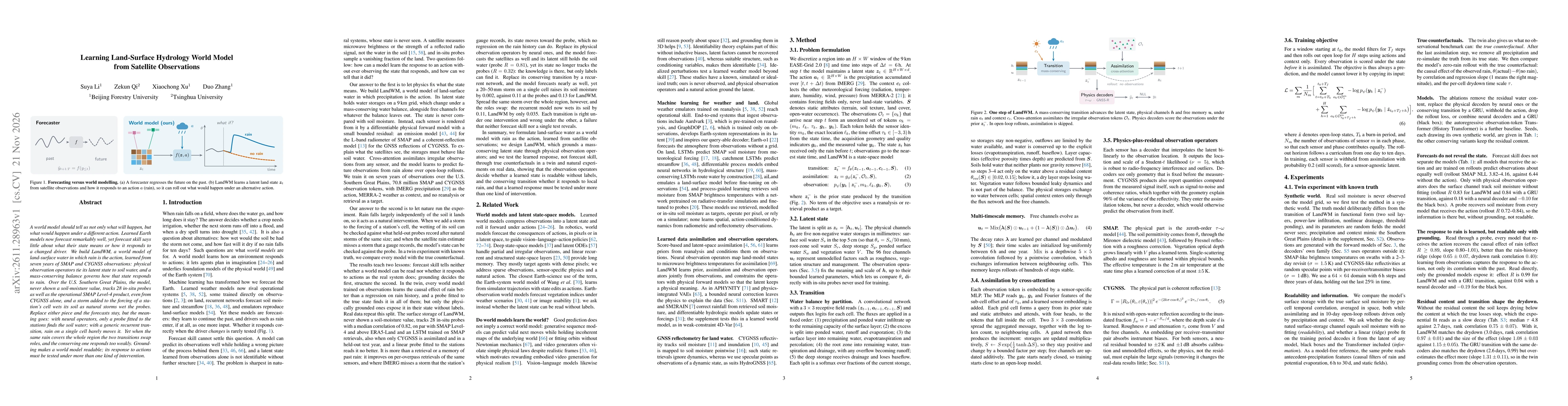
A world model should tell us not only what will happen, but what would happen under a different action. Learned Earth models now forecast remarkably well, yet forecast skill says little about what their state means or how it responds to a changed driver. We build LandWM, a world model of land-surface water in which rain is the action, learned from seven years of SMAP and CYGNSS observations: physical observation operators tie its latent state to soil water, and a mass-conserving balance governs how that state responds to rain. Over the U.S. Southern Great Plains, the model, never shown a soil-moisture value, tracks 28 in-situ probes as well as the operational SMAP Level-4 product, even from CYGNSS alone, and a storm added to the forcing of a station's cell wets its soil as natural storms wet the probes. Replace either piece and the forecasts stay, but the meaning goes: with neural operators, only a probe fitted to the stations finds the soil water; with a generic recurrent transition, rain on a single cell barely moves it. Yet when the same rain covers the whole region the two transitions swap roles, and the conserving one responds too weakly. Grounding makes a world model readable; its response to actions must be tested under more than one kind of intervention.
AI Key Findings
Get AI-generated insights about this paper's methodology, results, significance, and more — available when analysis has been generated.
Discussion 0