Learning Networked Dynamical Systems via Neural ODE-based Graph Structure Inference
Abstract
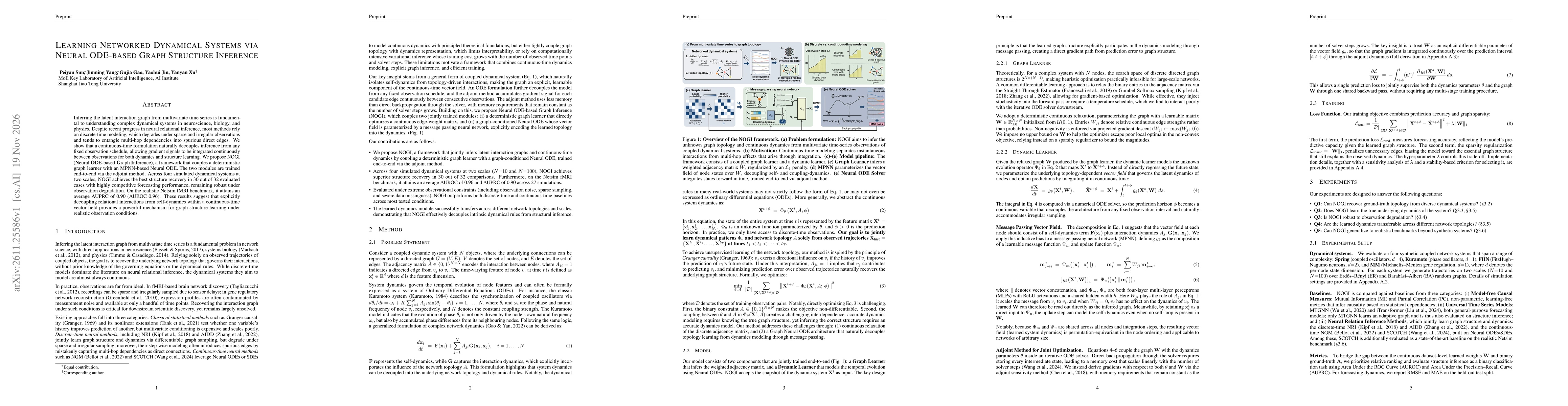
Inferring the latent interaction graph from multivariate time series is fundamental to understanding complex dynamical systems in neuroscience, biology, and physics. Despite recent progress in neural relational inference, most methods rely on discrete-time modeling, which degrades under sparse and irregular observations and tends to entangle multi-hop dependencies into spurious direct edges. We show that a continuous-time formulation naturally decouples inference from any fixed observation schedule, allowing gradient signals to be integrated continuously between observations for both dynamics and structure learning. We propose NOGI (Neural ODE-based Graph Inference), a framework that couples a deterministic graph learner with an MPNN-based Neural ODE. The two modules are trained end-to-end via the adjoint method. Across four simulated dynamical systems at two scales, NOGI achieves the best structure recovery in 30 out of 32 evaluated cases with highly competitive forecasting performance, remaining robust under observation degradation. On the realistic Netsim fMRI benchmark, it attains an average AUPRC of 0.90 (AUROC 0.96). These results suggest that explicitly decoupling relational interactions from self-dynamics within a continuous-time vector field provides a powerful mechanism for graph structure learning under realistic observation conditions.
Analysis
AI-generated · verify against the original paper
Generated Jan 1, 0001ResultsWhat the authors found
- NOGI achieves the best structure recovery in 30 out of 32 evaluated cases across four simulated dynamical systems at two scales.
- On the Netsim fMRI benchmark, NOGI attains an average AUPRC of 0.90 and AUROC of 0.96 across 27 simulations.
- The method remains robust under extreme observational constraints such as sparse sampling, observation noise, and missing data, outperforming both discrete-time and continuous-time baselines.
LimitationsWhere the findings need caution
- The framework relies on a deterministic graph learner, which may limit expressiveness compared to fully probabilistic approaches.
- Training efficiency depends on the adjoint method, which, while memory‑efficient, can be sensitive to solver step choices.
MethodologyHow the work was done
NOGI couples a deterministic graph learner with an MPNN-based Neural ODE, training both modules end-to-end via the adjoint method to infer latent interaction graphs from continuous-time multivariate time series.
SignificanceWhy the work matters
By decoupling relational interactions from self-dynamics within a continuous-time vector field, NOGI provides a powerful mechanism for graph structure learning under realistic, irregular observation conditions.
Technical contributionsWhat the work introduces
Introduces a continuous-time formulation that integrates gradient signals between observations and jointly learns graph topology and dynamics using a graph‑conditioned Neural ODE trained with the adjoint method.
NoveltyHow it differs from prior work
First to explicitly separate self‑dynamics from topology‑driven interactions in a Neural ODE framework, enabling robust graph inference under sparse and irregular sampling.
Discussion 0