Learning Task-Specific Antibody Representations via Function-Aware Masking
Abstract
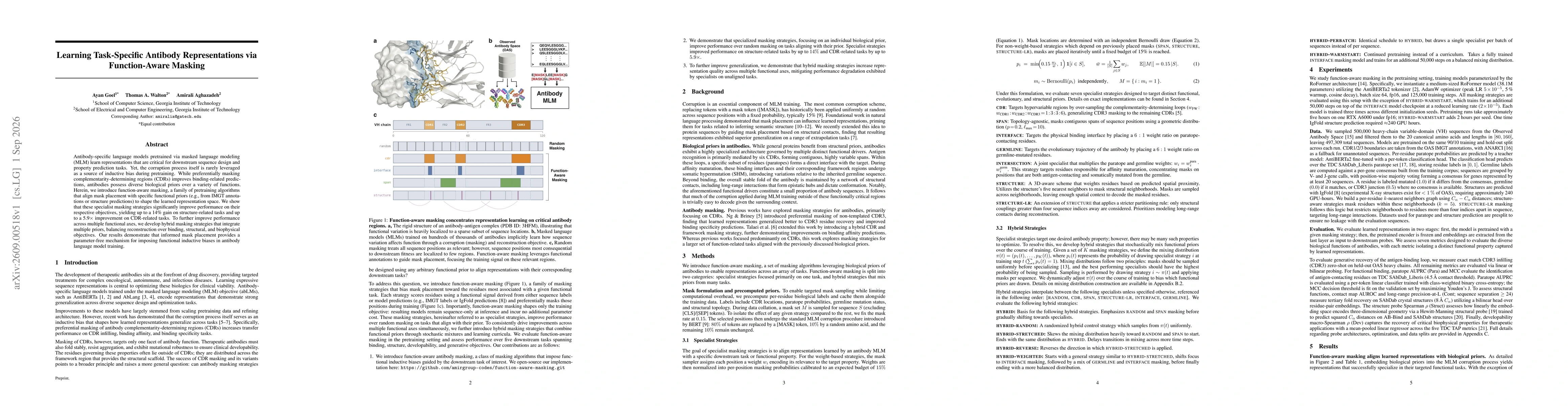
Antibody-specific language models pretrained via masked language modeling (MLM) learn representations that are critical for downstream sequence design and property prediction tasks. Yet, the corruption process itself is rarely leveraged as a source of inductive bias during pretraining. While preferentially masking complementarity-determining regions (CDRs) improves binding-related predictions, antibodies possess diverse biological priors over a variety of functions. Herein, we introduce function-aware masking, a family of pretraining algorithms that align mask placement with specific functional priors (e.g., from IMGT annotations or structure predictions) to shape the learned representation space. We show that these specialist masking strategies significantly improve performance on their respective objectives, yielding up to a 14% gain on structure-related tasks and up to a 5.9x improvement on CDR-related tasks. To further improve performance across multiple functional axes, we develop hybrid masking strategies that integrate multiple priors, balancing reconstruction over binding, structural, and biophysical objectives. Our results demonstrate that informed mask placement provides a parameter-free mechanism for imposing functional inductive biases in antibody language model training.
Analysis
AI-generated · verify against the original paper
Generated Jan 1, 0001ResultsWhat the authors found
- Specialist masking yields up to a 14% gain on structure-related tasks.
- Specialist masking yields up to a 5.9× improvement on CDR-related tasks.
- Hybrid masking strategies improve performance across multiple functional axes.
MethodologyHow the work was done
The authors design function-aware masking strategies that score residues using functional signals (e.g., IMGT annotations or IgFold structure predictions) and preferentially mask those positions during masked language model pretraining; they also create hybrid masking that combines multiple priors to balance reconstruction across binding, structural, and biophysical objectives.
SignificanceWhy the work matters
Informed mask placement provides a parameter‑free mechanism to impose functional inductive biases, substantially boosting antibody language model performance on downstream design and property prediction tasks.
Technical contributionsWhat the work introduces
Introduction of a family of function-aware masking algorithms—including specialist and hybrid variants—that align mask placement with functional priors to shape antibody representation learning.
NoveltyHow it differs from prior work
First work to leverage functional annotations (e.g., IMGT, predicted structure) for guiding mask placement in antibody language model pretraining, demonstrating that mask corruption can serve as an explicit inductive bias.
Discussion 0