Learning Unknown Oscillators From Bandit Feedback
Abstract
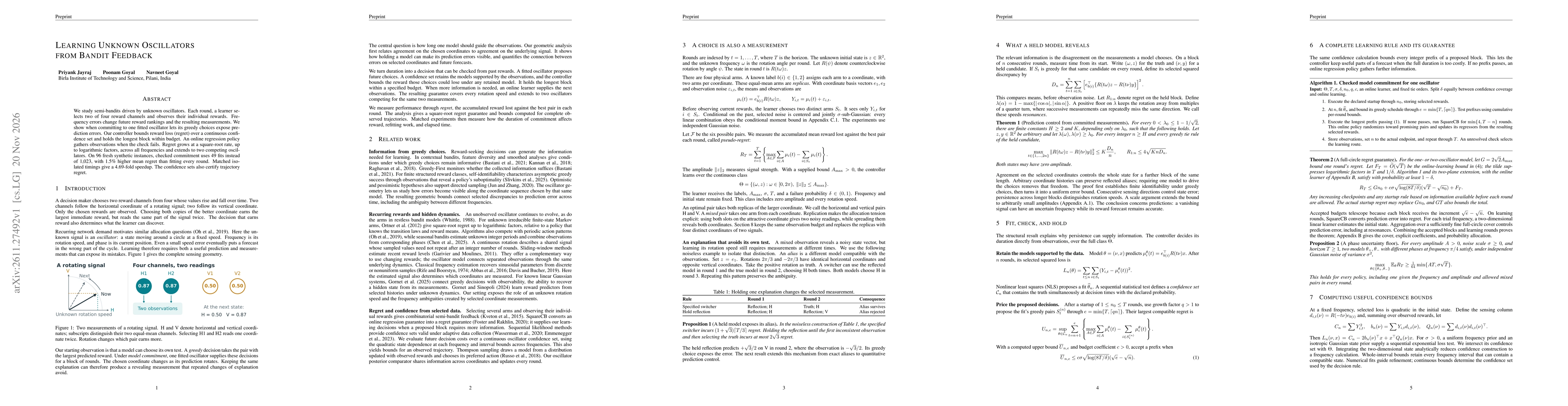
We study semi-bandits driven by unknown oscillators. Each round, a learner selects two of four reward channels and observes their individual rewards. Frequency errors change future reward rankings and the resulting measurements. We show when committing to one fitted oscillator lets its greedy choices expose prediction errors. Our controller bounds reward loss (regret) over a continuous confidence set and holds the longest block within budget. An online regression policy gathers observations when the check fails. Regret grows at a square-root rate, up to logarithmic factors, across all frequencies and extends to two competing oscillators. On 96 fresh synthetic instances, checked commitment uses 49 fits instead of 1,023, with 1.5% higher mean regret than fitting every round. Matched isolated timings give a 4.69-fold speedup. The confidence sets also certify trajectory regret.
Analysis
AI-generated · verify against the original paper
Generated Jan 1, 0001ResultsWhat the authors found
- Regret grows at a square‑root rate (up to logarithmic factors) across all frequencies and extends to two competing oscillators.
- Checked commitment uses only 49 fits instead of 1,023, incurring just 1.5% higher mean regret than fitting every round.
- Matched isolated timings show a 4.69‑fold speedup for the checked‑commitment method.
- Confidence sets also certify trajectory regret for observed paths.
LimitationsWhere the findings need caution
- Experiments are limited to synthetic data and specific oscillator configurations (e.g., two‑plane protocols, fixed horizons).
- The analysis assumes a bounded budget and may not directly generalize to unbounded or highly non‑stationary environments.
MethodologyHow the work was done
The paper studies a semi‑bandit problem where a learner selects two of four reward channels generated by an unknown rotating oscillator. It introduces a controller that commits to a single fitted oscillator for a block of rounds, using a continuous confidence set to bound possible regret and to determine the longest block within a budget. When the confidence check fails, an online nonlinear regression policy gathers additional observations. The approach is evaluated on synthetic instances with varying frequencies, amplitudes, phases, and noise levels, comparing checked commitment against frequent refitting.
SignificanceWhy the work matters
The work provides the first regret‑bounded controller for semi‑bandits driven by unknown oscillators, dramatically reducing computational overhead while maintaining near‑optimal regret, and it extends theoretical guarantees to multiple competing oscillators.
Technical contributionsWhat the work introduces
A geometric analysis linking agreement on chosen coordinates to underlying signal errors, a controller that bounds reward loss over a continuous confidence set and holds the longest block within a budget, and an online regression policy that triggers when confidence checks fail, together yielding square‑root regret guarantees and substantial computational savings.
NoveltyHow it differs from prior work
Introducing a commitment‑to‑a‑single‑fitted‑oscillator framework that makes prediction errors observable through greedy choices, and providing confidence‑set‑based regret certification for continuous‑time oscillatory bandit problems.
Discussion 0