Learning When to Think Aloud in Latent Reasoning
Abstract
Latent Chain-of-Thought (CoT) reasoning improves efficiency by shifting intermediate computation into continuous hidden states. However, fully latent methods often struggle on precision-critical tasks such as mathematical reasoning, while existing hybrid approaches retain substantial token-generation overhead. We introduce VITAL, an importance-guided hybrid reasoning framework that selectively verbalizes informative tokens as reasoning anchors while keeping most computation latent. A lightweight gating head dynamically selects between explicit token generation and direct hidden-state feedback. VITAL constructs hybrid trajectories from explicit CoT using token- importance estimation and trains the model through curriculum-based supervised training, followed by reinforcement learning with a reward that balances correctness and conciseness. Experiments show that VITAL consistently out- performs existing fully latent reasoning methods, achieving relative average accuracy gains of 9.6% on GPT-2 and 5.1% on Llama-3.2-1B at comparable reasoning lengths. Compared with hybrid baselines, VITAL achieves higher reasoning accuracy with substantially shorter reasoning trajectories on Qwen3-1.7B.
Analysis
AI-generated · verify against the original paper
Generated Jan 1, 0001ResultsWhat the authors found
- VITAL achieves a relative average accuracy gain of 9.6% on GPT‑2 and 5.1% on Llama‑3.2‑1B compared to fully latent baselines at comparable reasoning lengths.
- On Qwen‑3‑1.7B, VITAL outperforms hybrid baselines (TokenAssorted, HRPO) with higher accuracy and substantially shorter reasoning trajectories.
- For Llama‑3.2‑3B, VITAL attains 54.1% average accuracy using only 8.3 reasoning steps, surpassing the strongest latent baseline CODI by 2.1 percentage points.
LimitationsWhere the findings need caution
- Reinforcement‑learning fine‑tuning was not performed on the larger Llama‑3.2‑3B model due to limited computational resources, so only supervised results are reported for that backbone.
- The method relies on an external token‑importance scorer (LLM‑Lingua‑2), which may introduce additional overhead and dependency.
MethodologyHow the work was done
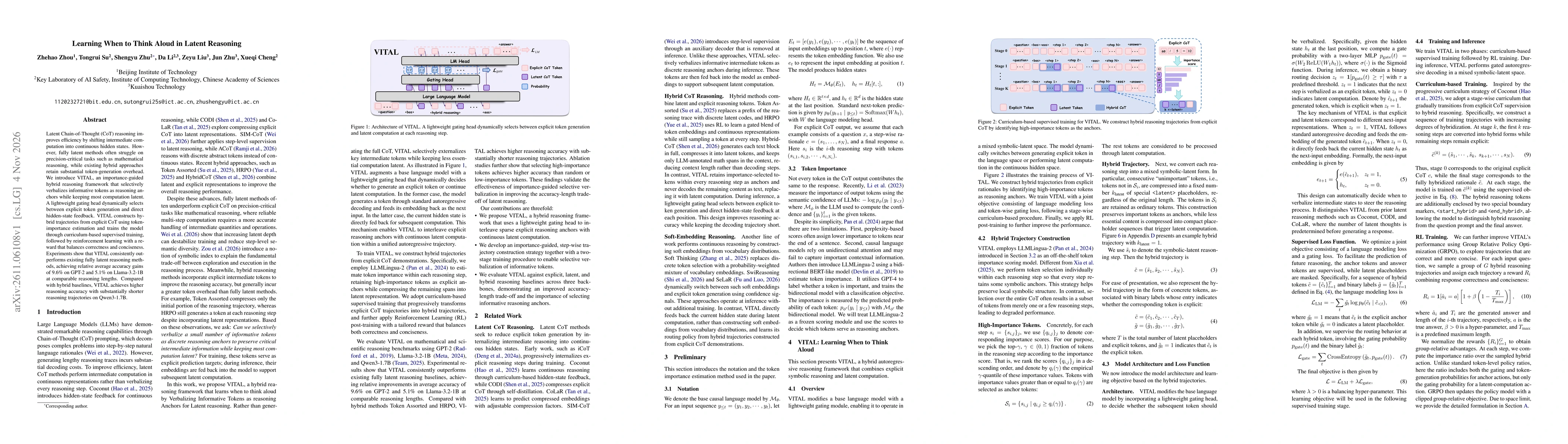
VITAL uses a lightweight gating head to dynamically choose between explicit token generation and latent hidden-state feedback at each reasoning step. Important tokens are identified via token‑importance estimation (LLM‑Lingua‑2) and retained as explicit reasoning anchors, while other steps remain latent. Training proceeds with curriculum‑based supervised learning that gradually transforms full CoT trajectories into hybrid ones, followed by reinforcement learning with a reward balancing correctness and conciseness.
SignificanceWhy the work matters
The work demonstrates that importance‑guided selective verbalization can substantially improve the accuracy‑length trade‑off in latent reasoning, enabling more efficient yet precise problem solving for mathematical and scientific tasks.
Technical contributionsWhat the work introduces
Introduction of a gating mechanism that interleaves explicit reasoning anchors with continuous latent computation, combined with an importance‑guided trajectory construction and a two‑stage training pipeline (curriculum supervised learning plus RL).
NoveltyHow it differs from prior work
First framework to dynamically decide when to ‘think aloud’ by verbalizing only high‑importance tokens while keeping the majority of reasoning latent, achieving better accuracy with fewer generated tokens than prior hybrid or fully latent approaches.
Discussion 0