Learning Where to Simulate: Generative Active Sampling for Online PDE Surrogate Training
Abstract
Data-driven PDE surrogates are trained with data produced by numerical PDE solvers. However, when the surrogate's goal is to generalize across a wide range of PDE configurations (e.g., initial conditions and physical coefficients), generating a representative training set is non-trivial. Uniform sampling of configuration parameters often under-represents trajectories exhibiting challenging dynamics, leading to high prediction errors and large error variance in the trained surrogate. Online training, where data generation and surrogate training are coupled, offers a natural advantage by allowing solver parameters to be steered on-the-fly. To efficiently exploit this capability, we introduce Online Generative Active Sampling (OGAS), an active learning method that reactively learns the relationship between configuration parameters and surrogate performance to control the sampling distribution. OGAS trains a fast diffusion model in parallel to the surrogate to act as a conditional sampler, mapping a surrogate-derived difficulty signal (e.g., loss or uncertainty) to configuration parameters. By actively drawing target signals from a prior biased toward high difficulty, OGAS continuously steers data generation toward challenging regimes without delaying the training workflow. We evaluate OGAS across 2D PDEs with distinct challenging dynamics (Kuramoto-Sivashinsky, Navier-Stokes, Gray-Scott) and up to 308 parameters, using multiple surrogate architectures. Across all settings, OGAS consistently improves tail statistics, yielding substantial reductions in errors above the 99th percentile and overall error dispersion compared to uniform sampling. While prioritizing challenging trajectories introduces a trade-off with average error, OGAS effectively ensures worst-case reliability of trained surrogates with negligible wall-time overhead.
Analysis
AI-generated · verify against the original paper
Generated Jan 1, 0001ResultsWhat the authors found
- OGAS consistently reduces the 99th-percentile prediction error across Kuramoto–Sivashinsky, Navier–Stokes, and Gray–Scott PDEs compared with uniform sampling.
- Overall error dispersion is lowered when using OGAS versus uniform and Sobol sampling.
- Wall-clock overhead of OGAS is negligible despite the additional generative model training.
MethodologyHow the work was done
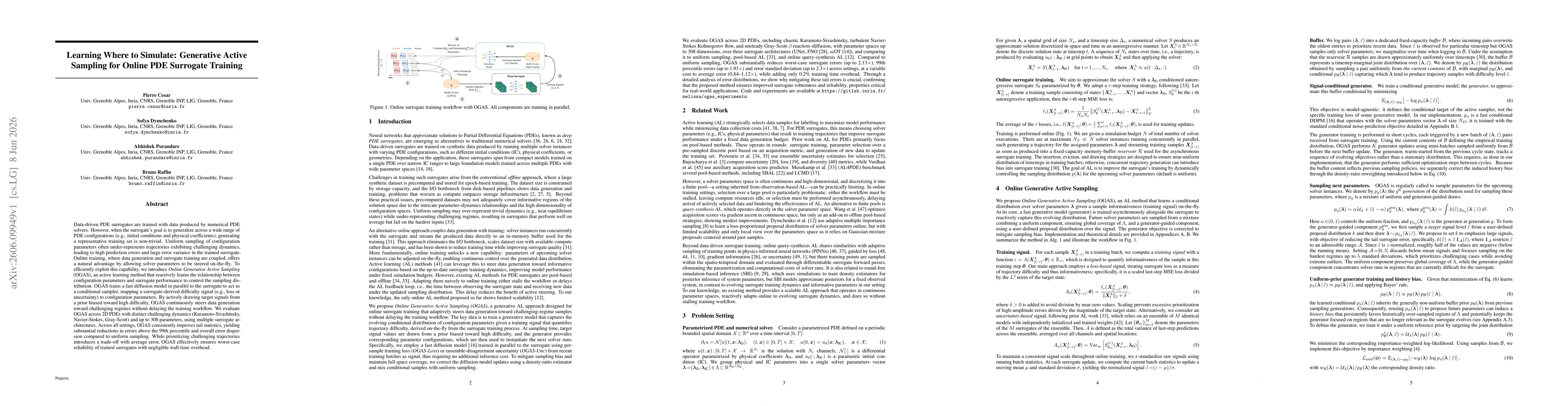
Online Generative Active Sampling (OGAS) continuously adapts configuration sampling during surrogate training by training a fast diffusion model in parallel to generate configuration parameters conditioned on a difficulty signal (loss or uncertainty), and uses this conditional sampler to prioritize challenging simulations.
SignificanceWhy the work matters
The approach enables data-driven PDE surrogates to focus computational resources on hard-to-learn regimes, improving worst-case performance and reliability without extra computational cost.
Technical contributionsWhat the work introduces
A query-synthesis active learning framework that integrates a conditional diffusion model to generate high-difficulty configurations on-the-fly, combined with density-ratio correction and mixing with uniform samples for balanced coverage.
NoveltyHow it differs from prior work
First online active sampling method that leverages a generative diffusion model conditioned on surrogate difficulty signals to adaptively steer simulation generation during training.
Discussion 0