LeCompass: Task-Level Execution through State-Indexed Interfaces
Abstract
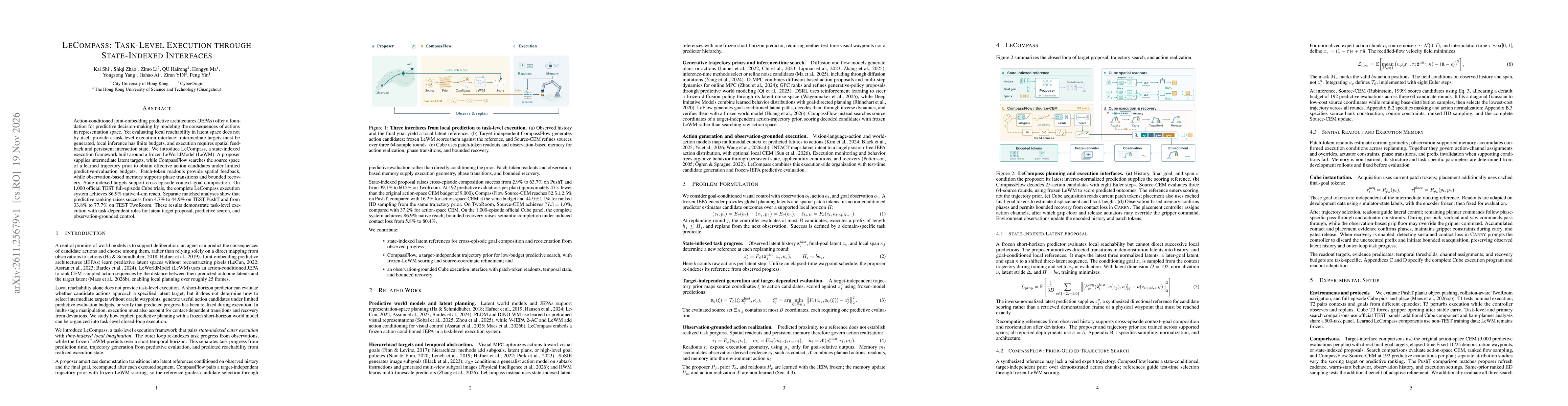
Action-conditioned joint-embedding predictive architectures (JEPAs) offer a foundation for predictive decision-making by modeling the consequences of actions in representation space. Yet evaluating local reachability in latent space does not by itself provide a task-level execution interface: intermediate targets must be generated, local inference has finite budgets, and execution requires spatial feedback and persistent interaction state. We introduce LeCompass, a state-indexed execution framework built around a frozen LeWorldModel (LeWM). A proposer supplies intermediate latent targets, while CompassFlow searches the source space of a learned trajectory prior to obtain effective action candidates under limited predictive-evaluation budgets. Patch-token readouts provide spatial feedback, while observation-based memory supports phase transitions and bounded recovery. State-indexed targets support cross-episode context-goal composition. On 1,000 official TEST full-episode Cube trials, the complete LeCompass execution system achieves 86.9% native 4-cm reach. Separate matched analyses show that predictive ranking raises success from 4.7% to 44.9% on TEST PushT and from 33.8% to 77.7% on TEST TwoRoom. These results demonstrate task-level execution with task-dependent roles for latent target proposal, predictive search, and observation-grounded control.
Analysis
AI-generated · verify against the original paper
Generated Jan 1, 0001ResultsWhat the authors found
- 86.9% native 4‑cm reach on 1,000 full‑episode Cube trials.
- Predictive ranking raises success from 4.7% to 44.9% on TEST PushT and from 33.8% to 77.7% on TEST TwoRoom.
- State‑indexed proposal improves cross‑episode composition success from 2.9% to 63.7% on PushT and from 39.1% to 60.5% on TwoRoom.
- Source‑CEM with 192 predictive evaluations achieves 52.5%±2.5% on PushT (vs 16.2% for action‑space CEM) and 77.3%±1.0% on TwoRoom (vs 37.2%).
- Bounded recovery raises semantic completion under contact loss from 5.8% to 80.4%.
LimitationsWhere the findings need caution
- The system relies on a frozen LeWM and limited predictive‑evaluation budgets, which may restrict adaptability to novel dynamics.
- Evaluations are confined to the Cube, PushT, and TwoRoom domains, leaving generalization to other tasks untested.
MethodologyHow the work was done
LeCompass combines a frozen LeWorldModel (LeWM) with a state-indexed proposer that generates intermediate latent targets, and CompassFlow which searches a learned trajectory prior using source-CEM under limited predictive-evaluation budgets; execution uses patch-token readouts for spatial feedback and observation-based memory for phase transitions and bounded recovery.
SignificanceWhy the work matters
The results demonstrate that a frozen latent world model can be orchestrated into a task‑level execution system, providing a practical interface for complex manipulation through latent target proposal, low‑budget predictive search, and observation‑grounded control.
Technical contributionsWhat the work introduces
Introduces state‑indexed latent references for cross‑episode goal composition, CompassFlow as a target‑independent trajectory prior with source‑CEM scoring, and an observation‑grounded execution interface using patch‑token readouts and bounded recovery memory.
NoveltyHow it differs from prior work
First integration of a frozen action‑conditioned JEPA with state‑indexed latent target proposal and low‑budget source‑CEM search to achieve closed‑loop task‑level execution.
Discussion 0