The study reports the first lasing from a levitated dye droplet, achieved through precise pico-liter dispensing into an ultrasonic wave node, resulting in a high-quality optical resonator. The Rhodamine 6G dye droplet optically pumped at 532 nm emits lasing spectra in the visible range of 610-650 nm, demonstrating potential for sensitive intra-cavity absorbance detection.
Abstract
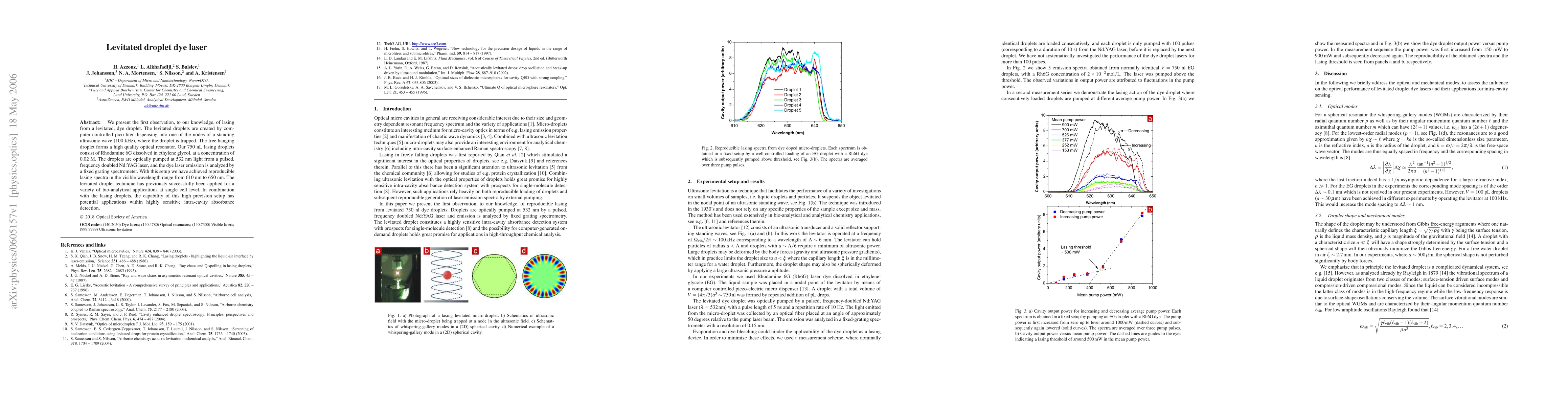
We present the first observation, to our knowledge, of lasing from a levitated, dye droplet. The levitated droplets are created by computer controlled pico-liter dispensing into one of the nodes of a standing ultrasonic wave (100 kHz), where the droplet is trapped. The free hanging droplet forms a high quality optical resonator. Our 750 nL lasing droplets consist of Rhodamine 6G dissolved in ethylene glycol, at a concentration of 0.02 M. The droplets are optically pumped at 532 nm light from a pulsed, frequency doubled Nd:YAG laser, and the dye laser emission is analyzed by a fixed grating spectrometer. With this setup we have achieved reproducible lasing spectra in the visible wavelength range from 610 nm to 650 nm. The levitated droplet technique has previously successfully been applied for a variety of bio-analytical applications at single cell level. In combination with the lasing droplets, the capability of this high precision setup has potential applications within highly sensitive intra-cavity absorbance detection.
AI Key Findings
Get AI-generated insights about this paper's methodology, results, significance, and more — available when analysis has been generated.
Discussion 0