Linear entanglement suffices for $f$-routing
Abstract
In $f$-routing, Alice receives an $n$-bit string $x$ and an unknown qubit, and Bob receives an $n$-bit string $y$. They share a state prepared in advance and exchange one simultaneous message each. The party selected by the Boolean function $f(x,y)$ must then recover the unknown qubit without further communication. To perform $f$-routing successfully, Alice and Bob need to share entanglement that scales with $n$ for some functions $f$, but the lower and upper bounds for the entanglement are not tight. This paper shows that $2n+2$ shared EPR pairs suffice for every function $f$. The best previous bound that holds for all functions is a shared state of $2^{O(\sqrt{n\log n})}$ qubits. The new strategy moves the cost from the shared state to the messages: Alice sends an exponentially long message of $2^{n+1}+1$ qubits, while Bob sends only classical bits. When the messages are counted towards the resources as well, the previous strategy remains the cheapest known. The result also limits lower bounds that count only the shared state: they cannot exceed a linear number of EPR pairs. The result is formalized in Lean.
Analysis
AI-generated · verify against the original paper
Generated Jan 1, 0001ResultsWhat the authors found
- 2n+2 shared EPR pairs are sufficient for exact f‑routing for every Boolean function.
- Alice’s quantum message length is 2^{n+1}+1 qubits, while Bob transmits only 3n+2 classical bits.
- The new upper bound improves the previous universal bound of a shared state of 2^{O(\sqrt{n\log n})} qubits.
- The result shows that any lower bound counting only the shared state cannot exceed a linear number of EPR pairs.
LimitationsWhere the findings need caution
- The protocol requires an exponentially long quantum message from Alice, making it impractical when message size is counted as a resource.
- When messages are included in the resource count, the previous strategy with 2^{O(\sqrt{n\log n})} qubits remains the cheapest known.
MethodologyHow the work was done
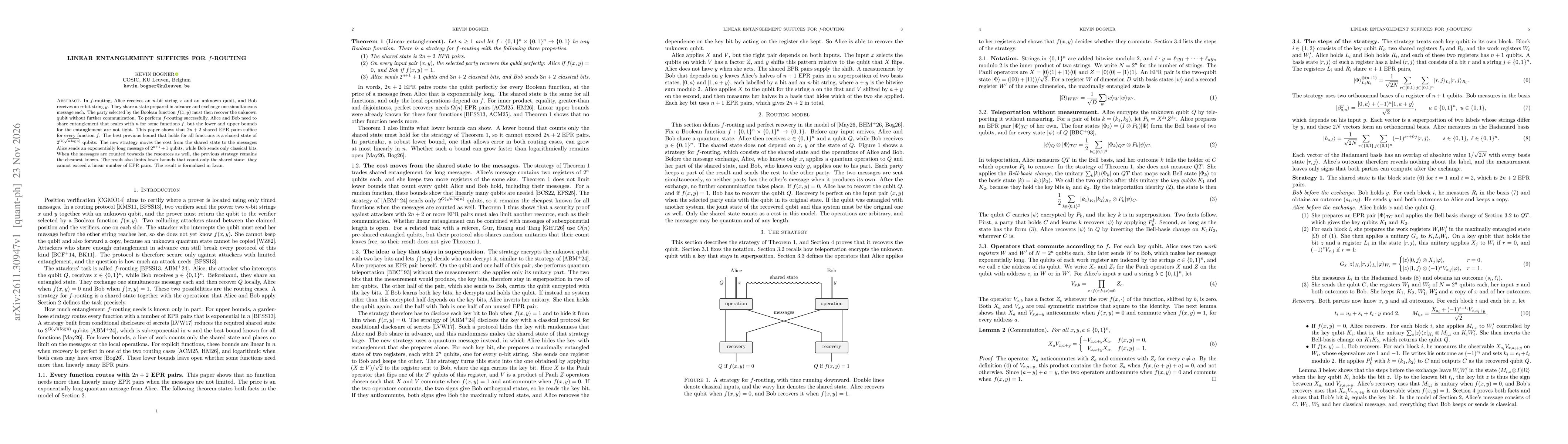
The authors construct a protocol where Alice and Bob share 2n+2 EPR pairs and Alice sends an exponentially long quantum message of 2^{n+1}+1 qubits while Bob sends only classical bits; the protocol uses quantum teleportation without measurement, key bits kept in superposition, and conditional disclosure of secrets to achieve perfect recovery of the unknown qubit for any Boolean function f.
SignificanceWhy the work matters
This establishes the first linear‑entanglement upper bound for f‑routing across all functions, tightening the gap between known upper and lower bounds and informing security analyses of position‑verification protocols.
Technical contributionsWhat the work introduces
The paper provides a concrete f‑routing protocol with linear entanglement and formalizes the proof of correctness in the Lean theorem prover, releasing the accompanying code.
NoveltyHow it differs from prior work
It is the first work to prove that linear (2n+2) entanglement suffices for f‑routing for any Boolean function, shifting the resource trade‑off from shared entanglement to message length.
Future workQuestions that remain
- Determine whether there exists a function that requires \Omega(n) EPR pairs with constant error when messages are unrestricted.
- Investigate if messages can be shortened, e.g., achieving sub‑exponential length while retaining O(n) EPR pairs.
Discussion 0